

England
Land remembered the loser.

A noble game of Crowns, Signs, honor, and speed.
Once played, so the old stories claim, by cardinals beneath Vatican candles, by English lords over maps of disputed land, and by courtiers in the jeweled rooms of France, Astral Assembly, also known in certain courts as Astral Array, is a contest of sharp eyes, quicker judgment, and shifting omens.
The dice are public.
The intentions are not.
Read the Celestial Pool. Shape your Assembly Row. Call the Sign before the final sand escapes the glass.
For those who believe thought should move faster than fortune.
A Game of Courts, Crowns, and Quiet Ambition
Before it was called Astral Assembly, some knew it as Astral Array.
The name changed from court to court, but the table remained the same: Astral dice at the center, the Oracle pair waiting apart, an hourglass breathing sand, and players who understood that hesitation could be more costly than defeat.
Old stories place the game in candlelit Vatican chambers, where cardinals wagered influence rather than coin. They place it in the halls of England, where lords are said to have risked land, rents, and river rights on a single sign. They place it beneath the chandeliers of France, where courtiers watched not only the dice, but the hands that dared to move them.
Whether such tales are history or ornament is left to the player.
What matters is the feeling they preserve:
A noble game.
Easy to enter.
Difficult to command.
Merciless to the slow of mind.
In Astral Assembly, every die is visible, yet every intention is hidden. The winner is not always the boldest, nor the luckiest, nor the richest at the table.
The winner is the one who sees the stars assemble first.
The official history of Astral Assembly
Land remembered the loser.
Influence was the wager.
Hesitation was entertainment.
There are games made for taverns, games made for soldiers, and games made for children beneath the stairs.
Then there is Astral Assembly.
In certain old corners of Europe, where the records are perfumed with dust and candle smoke, the game is also known as Astral Array. Some say this was its older name, used in the private libraries of bishops and princes. Others claim the two names belonged to rival courts, each too proud to adopt the other's tongue.
Whatever name was spoken, the meaning was understood.
At the heart of the table lay the Oracle, whose two judgments named the Halo and Dots of the hour.
This was a game for those who wished to prove the sharpness of the mind before witnesses.
Not strength.
Not wealth.
Not birth alone.
A player sat at the table with nothing but eyes, nerve, memory, and the courage to act before the last sand slipped through the hourglass.
The earliest tales place Astral Assembly in rooms where ordinary men were never invited.
It was played behind carved doors in the Vatican, among cardinals whose rings caught the firelight as they reached toward the Celestial Pool. They did not always wager gold. Gold was a small thing to men who could summon it with a letter. Instead, they wagered influence. A name advanced. A post promised. A silence purchased. A door opened at the right hour.
There are whispers of one cardinal who won three games before midnight and, by dawn, saw his favored nephew placed in a position that had been denied him for years.
Whether this story is true is less important than the fact that it was believed.
From Rome, the game moved northward, as all dangerous amusements eventually do. In England, high lords played it in long halls while rain struck the windows and dogs slept beneath the table. They wagered hunting rights, parcels of land, winter rents, and once, according to a much-disputed account, a strip of riverbank that later became the cause of a thirty-year family quarrel.
A careless lord might lose a vineyard.
A patient one might win a valley.
A brilliant one might win both and leave the table before dessert.
In France, Astral Assembly became a jewel of the royal courts. There, it was played on polished tables beneath chandeliers, surrounded by silk sleeves, painted fans, powdered faces, and watchful smiles. Courtiers gathered not merely to see who would win, but to see who would hesitate.
For hesitation, in court as in Astral Assembly, was often fatal.
Those who have only read the rules cannot understand the music of the game.
The soft scrape of a die drawn from the Celestial Pool.
The bright clatter as dice are stirred and cast back among the others.
The breath that catches when a Crown appears.
The hush that follows the Oracle's judgment.
The small, terrible silence before a player says, "Astral Sign."
Above it all waits the timer.
In the oldest houses, it was an hourglass, narrow as a throat. The sand did not fall. It lingered. It threatened. It reminded every noble hand at the table that thought is precious only when it arrives in time.
A player might see the pattern forming.
A player might know the perfect move.
But knowledge trapped behind delay is no better than ignorance.
So the hand must move.
The die must turn.
The Sign must be called.
The stars favor the swift, but they do not forgive the foolish.
Astral Assembly earned its reputation as a noble game because its gates stood open, yet its throne remained distant.
A child could learn the motions. Claim. Recast. Shift. Parley. Stir the Pool.
But mastery was another matter.
To Claim is to declare desire.
To Recast is to cast one certainty back into chaos.
To Shift is to touch fate with a single finger.
To Parley is to smile while measuring another soul.
To Stir the Pool is to confess that the heavens, as they stand, are not yet worthy of you.
Every die is visible, yet nothing is simple. Every player sees the same table, but not every player sees the same future. The novice watches their own Assembly Row. The practiced player watches all rows. The master watches the row, the pool, the Oracle, the hands, the hunger, the fear, and the time.
This is why kings loved it.
A battlefield could be blamed on weather.
A council could be blamed on poor advice.
But across the Astral table, under the gaze of rivals, there was nowhere to hide.
A king who played badly looked mortal.
A cardinal who called falsely looked vain.
A lord who missed an obvious sign was remembered for it longer than he wished.
The game's three Astral Signs were not always treated as mere patterns. In the old courts, they were read almost as omens.
The Omen was the sign of hidden truth. Three Crowns gathered around one die that answered the Oracle’s Halo, its Dots, or both.
The Seal was the sign of authority. Two Crowns stood over exact twins, except when both their Halo and Dots echoed the Oracle Stand.
The Eclipse was the sign of brilliance. One Crown stood above three bodies whose shared Dots and three Halos matched neither part of the Oracle Stand.
To complete a sign was not simply to score. It was to reveal, for one shining instant, that the chaos of the table had obeyed your mind.
The grandest legends of Astral Assembly are, naturally, the least trustworthy.
One tells of an English duke who entered a match with three estates and left with two, yet laughed as though he had won, because the estate he lost was swamp and debt from border to border.
Another tells of a French courtier who won a royal favor on an Eclipse made with only a breath of sand remaining in the glass. He later spent that favor to marry above his station, which proves either the power of the game or the recklessness of love.
In Rome, it was said that certain games ended without applause. The winning player would merely collect his score, kiss his ring, and leave the room, while the losers sat very still, already calculating what the victory would cost them by morning.
Such stories are part of the game. They cling to the dice like candle wax.
Perhaps no king truly lost a province over Astral Assembly.
Perhaps no cardinal truly traded a bishopric across the Celestial Pool.
Perhaps no queen ever watched from behind a veil and chose her favorite by the steadiness of his hand.
But every player, sooner or later, understands why such stories were told.
The game makes the table feel royal.
It makes silence feel expensive.
It makes a single die feel heavy enough to change a kingdom.
Astral Assembly preserves the challenge.
The Celestial Pool waits at the center.
The Crowns glitter with promise.
The Oracle names the Halo and Dots of the hour.
The Signs appear and vanish as the heavens change their mind.
Around the table, every player becomes something more than a player. A strategist. A courtier. A rival. A mind under judgment.
The dice strike the table.
The sand continues its descent.
Someone sees the pattern.
Someone sees it too late.
And then, with the calm of a monarch or the certainty of a cardinal, one voice rises above the hush:
"Astral Sign."
Read the stars.
Shape the sign.
Prove your mind before the court.
The Noble Game, Plainly Spoken
Astral Assembly is a fast tactical dice game of pattern, pressure, and perception.
Players gather around a shared field of dice called the Celestial Pool. On each turn, a player takes, turns, trades, rerolls, or disturbs the dice, trying to build a private Assembly Row of exactly four dice.
But a row is not enough.
To score, the row must form one of the three Astral Signs: the Omen, the Seal, or the Eclipse. Crowns complete Signs but do not score.
The two Oracle dice show the current Oracle Stand. It opens one path for Omen while limiting Seal and Eclipse.
The game is won by the player who scores the most non-Crown dice before the Pool runs low.
Every die is public.
Every choice is visible.
Every intention is concealed.
The rules are learned quickly. The table is read slowly. Mastery belongs to the player who can see order in the scatter before anyone else dares to move.
A game of open information, hidden plans, and royal pressure.
Open Dice. Hidden Intentions.
At the center of every game lies the Celestial Pool, a scatter of public Astral dice shared by all players. Nearby, the Oracle Stand names the Halo and Dots of the hour.
Nothing is hidden there.
And yet, nothing is safe.
A Crown may wait in plain sight, desired by three players at once. A Moon may seem useless until a single Shift turns a row toward destiny. A Star may become part of an Eclipse only while its Halo and Dots keep clear of the Oracle Stand.
Around the Pool, each player builds an Assembly Row. The rows are visible. The danger is visible. The ambition is visible. But intention is not.
One player Claims with confidence. Another Recasts with a calm hand and a desperate mind. A third does nothing to your row, then asks for Parley at the exact moment you understand what they have seen.
Above the table, the timer waits.
The sand lingers.
The dice strike wood.
The room grows quiet.
Someone sees the Sign.
In Astral Assembly, every turn is small enough to understand and sharp enough to matter. Each scored Sign reads the Oracle: Omen rolls both dice, while Seal or Eclipse keeps one part of the Stand fixed. Both displayed dice judge the result. A Crownless Stand may bless a rival, while one Crown calls matching dice from the Assembly Rows back into the Pool.
The table rewards the player who can look at disorder and see a path.
The dice are public. The mistake is private until the table hears it.
The Celestial Pool belongs to everyone. Every Crown, Dot value, Halo, and part of the Oracle Stand may matter. Look for exact twins, safe Eclipse families, and Omen dice matching the Oracle Halo or Dots.
Your rivals build in public. Their Assembly Rows reveal what they want, what they fear, and what they are one die away from completing.
The hourglass does not rush. It simply continues. The player who thinks too long gives the table permission to punish them.
A Shift, a Parley, a Stir of the Pool, or an Oracle roll can change the shape of the game before a Sign appears. In Astral Assembly, defense can be as elegant as offense, but a careless Shift or Oracle resolution may bless a rival.
At this table, the stars do not belong to the lucky. They belong to the player who sees the pattern first.
When Chaos Agrees to Form
A player does not score by gathering beautiful dice.
A player scores by assembling a Sign.
Each Astral Sign is made of exactly four dice in an Assembly Row. Each must contain at least one Crown, for no noble pattern is recognized without authority.
But Crowns are not trophies. They are keys.
When a Sign is called, the non-Crown dice move to the score pile. The Crowns return to the Celestial Pool, rolled back into the common fate of the table.
The Halo Oracle and Dots Oracle form the current Oracle Stand. Each Sign relates to that Halo and Dot value differently.
Signs are normally read from the top faces. A Blessing in Disguise may also reveal a complete Sign along one common visible side of the row.
Three Signs are known.
One is sudden.
One is balanced.
One is brilliant.
A single truth surrounded by power.
3 Crowns and 1 die matching the Oracle Halo or Dots
Exactly 3 Crowns and 1 non-Crown die.
The non-Crown must match the Oracle Halo, the Oracle Dots, or both.
Matching both makes it a Perfect Omen.
The non-Crown die scores 1 point. The Crowns return to the Celestial Pool.
A normal Omen reads the Oracle by rolling both dice. A Perfect Omen may instead set both Oracle dice directly to any Crownless Stand.
A chosen Stand resolves its Blessings and nothing else. Choosing to roll commits the player to every Crown effect and the first Crownless Stand rolled.
The Omen appears when three Crowns gather around a die that answers at least one part of the Oracle Stand.
Authority made precise.
2 Crowns and exact twins that do not match the full Oracle Stand
Exactly 2 Crowns and 2 non-Crown dice.
The two non-Crown dice must have the same Shape, the same Dots, and the same Halo.
The pair may match one part of the Oracle Stand or neither, but not both.
The two non-Crown dice score 2 points. The Crowns return to the Celestial Pool.
Keep the Halo Oracle fixed and read the Oracle by rolling only the Dots Oracle.
The Seal is a Sign of judgment. It rewards the player who recognizes perfect sameness: two identical lesser powers authorized by two Crowns.
Brilliance under a single Crown.
Three non-Oracle Halos and non-Oracle Dots
Exactly 1 Crown and 3 non-Crown dice.
The three non-Crown dice must share Shape and Dots, use the three Halos other than the Oracle Halo, and have a Dot value different from the Oracle Dots.
The three non-Crown dice score 3 points. The Crown returns to the Celestial Pool.
Keep the Dots Oracle fixed and read the Oracle by rolling only the Halo Oracle.
The Eclipse demands three matching bodies beneath one Crown, using neither the Halo nor the Dots named by the Oracle Stand.
A valid Astral Sign is exactly 4 dice, includes at least 1 Crown, and can never be 4 Crowns. Only non-Crown dice score.
Every Sign requires a Crown.
No Sign may be made of four Crowns.
No Crown is ever scored.
Every scored Sign reads the Oracle. Omen rolls both dice. Seal rolls only Dots with Halo fixed. Eclipse rolls only Halo with Dots fixed. The fixed die remains part of the result. A Perfect Omen may set a Crownless Stand directly.
The Crown grants authority, then leaves the hand.
To win Astral Assembly, a player must learn when to chase Crowns, when to release them, and when to call the Sign before the table understands what has already happened.
The Sign is not found. It is assembled.
The Ritual of a Turn
Astral Assembly is learned in moments, then studied for years.
Each turn is simple: choose one action, change the table, and look for a Sign. Yet every choice enters a shared field of pressure, memory, and ambition.
The Celestial Pool waits at the center.
Your Assembly Row waits before you.
The hourglass is turned.
Then the table belongs to your hand.
First choose the starting player by the dot roll. That player rolls both Oracle dice together until neither shows Crown. Ignore Crown effects during setup. The Oracle Halo and Oracle Dots establish the first Oracle Stand.
Then divide the 48 Astral dice as evenly as possible and roll them into the middle to form the Celestial Pool. All Pool and Assembly Row dice are public. Play clockwise.
The two Oracle dice are separate from the Astral dice and never enter the Pool.
On your turn, choose one action. You may Claim, Recast, Shift, Parley, or Stir the Pool while watching both parts of the Oracle Stand.
Your goal is to build an Assembly Row of exactly four dice.
Your Assembly Row can hold up to 4 dice.
No Astral Sign can be completed without a Crown.
Crowns do not score, but they grant authority to the pattern. A row without a Crown is only a row. A row with the right Crown may become a Sign.
A valid Sign must include at least 1 Crown and cannot include 4 Crowns.
When the top faces of exactly four dice in your Assembly Row match the Omen, the Seal, or the Eclipse, say:
Astral Sign!
The timer stops. The pattern is judged against the Oracle Stand: Omen matches at least one part, Seal cannot match both, and Eclipse matches neither.
A Sign is checked at the end of your turn.
Move all non-Crown dice from your completed Sign to your score pile. Each one is worth 1 point.
Return every Crown to the Celestial Pool and reroll it.
After scoring, read the Oracle for that Sign: Omen rolls both dice, Seal rolls only Dots with Halo fixed, and Eclipse rolls only Halo with Dots fixed.
Perfect Omen may set any Crownless Stand and resolve its Blessings, or roll, resolve every Crown effect, and accept the first Crownless Stand.
The Crown opens the way, then leaves the hand.
Each non-Crown die scores 1 point.
As players build and score, dice leave the table and the Celestial Pool may grow smaller. Oracle judgments, Crown returns, penalties, and Sacrifice can send dice back. When the Pool reaches the End Limit, finish the current turn and continue to the end of the round. The game closes after the player immediately to the starting player’s right finishes their turn.
The player with the most scored dice wins.
The End Limit depends on player count.
That is the game in its simplest form:
Read the Pool.
Watch the Oracle.
Build the Row.
Use the Crown.
Call the Sign.
Score what remains.
Read the Oracle.
The rules are few. The consequences are not.
For complete Oracle Stand, Blessing, timing, penalty, and endgame rules.
Every Turn, One Choice
On your turn, you do not move an army.
You touch one part of the table.
One die taken.
One die returned.
One direction turned.
One bargain offered.
One handful of fate cast back into the Pool.
Astral Assembly is built on small actions with large consequences. A Claim may complete a quiet plan. A Recast may rescue a failing row. A Shift may open a Sign or ruin one. A Parley may reveal more than it gains. A Stir may change the heavens for everyone.
Choose carefully.
The hourglass is already falling.
One Turn. One Action. One Consequence.
Take desire into your hand.
Take 1 die from the Celestial Pool and place it in your Assembly Row. You may Claim only if your Assembly Row has fewer than 4 dice.
Claim is the cleanest action, and therefore the most revealing. The table sees whether you value a Crown, an exact twin, an Eclipse family, or either part of the Oracle Stand. Keep the top face, choose its direction, then leave that orientation fixed.
A Claim says, “I have seen something.”
Return certainty to chaos.
Return 1 die from your Assembly Row to the Celestial Pool and reroll it. Then take 1 die from the Celestial Pool and place it in your Assembly Row. You may Recast only if you already have at least 1 die in your Assembly Row.
Recast is the action of correction and risk. It gives up a piece of your plan, but it also lets you reach for something better. A wise Recast can turn a failing row into a threat. A desperate Recast can tell the whole table that your plan has begun to collapse.
A Recast says, “The stars were wrong. I will ask again.”
Touch fate by one direction.
Choose one table direction. Turn either all dice in your Assembly Row one step that way, or 1 die in one opponent’s Row. A Shift must turn at least 1 die. You may not Shift the same opponent on consecutive turns. Do not inspect hidden faces before choosing. If your Shift gives an opponent a valid Sign on top or along one common visible side, resolve Blessing in Disguise.
If your Shift or an Oracle resolution during your turn gives an opponent a valid Astral Sign on top or along one common visible side, they can immediately call and score it as a Blessing in Disguise. After scoring, they also take two dice from your score pile and add them to their own. If you have fewer than two dice in your score pile, they take as many as possible. If your score pile is empty, no additional dice are taken. Queue that Sign’s Oracle reading until the current Blessings finish.
Shift is a directional command. The top offers one immediate scoring view, while four lateral views can hold future Shift routes or concealed Blessings. Those faces are public, but easier to overlook in practice. Used against an opponent, Shift can disturb their plan, but it can also crown them.
A Shift says, “Your future is not as stable as you think.”
Smile, bargain, and measure the room.
Ask another player to swap 1 die from their Assembly Row for 1 die from your Assembly Row. The timer is paused until the opponent answers. You may Parley only if both players have at least 1 die in their Assembly Rows. If both players agree, swap the chosen dice without changing their top faces or table-facing directions. If the other player refuses, you must choose a different action before the timer expires. If another player’s top faces form an Astral Sign because of your Parley, they may call it only on their own turn.
Parley is the social action. It is bargain, bluff, request, threat, and confession. Sometimes you Parley because you need the die. Sometimes you Parley to discover whether your opponent knows what it is worth.
A Parley says, “I know what you have. Do you know why I want it?”
Make the heavens speak again.
Reroll up to 4 dice from the Celestial Pool. This does not change your Assembly Row.
Stir the Pool uses your turn action.
Stir targets only the Pool and leaves every Assembly Row untouched.
A Stir says, “Let no one grow too comfortable beneath these stars.”
Choose an action to feel its pressure.
Choose Claim to gain.
Choose Recast to repair.
Choose Shift to alter.
Choose Parley to bargain.
Choose Stir to unsettle.
The five actions are simple enough to learn before the first hourglass falls.
But their meanings change with every table.
Claim when the path is clear.
Recast when the path has failed.
Shift when fate is close enough to touch.
Parley when another player holds your future.
Stir the Pool when the stars must be scattered.
A master does not merely know the actions.
A master knows when one quiet move is enough to make the whole table afraid.
In Astral Assembly, power is rarely loud. It is usually one die, moved at the perfect time.
The Law of the Table
Every noble game requires a law.
Here you will find the complete rules of Astral Assembly, from the first roll into the Celestial Pool to the final judgment of the last Sign.
Read them before your first game.
Return to them when the table disagrees.
Let them settle every Crown, Shift, Parley, Sacrifice, and false call.
The dice may fall in chaos.
The rules must not.
The official rules below are written for play, not ornament. They should be followed exactly during a match.
Consult before judgment.
No law of the table matches that search.
Assemble a 4-dice Astral Sign from the Celestial Pool.
In each Astral Sign, you score dice; each scored die is worth 1 point. The player with the most points wins.
On your turn, you manipulate dice in the shared Celestial Pool or in Assembly Rows. Your goal is to build exactly 4 dice in your Assembly Row, including at least 1 Crown, that match one of the three Astral Signs. Non-Crown dice score points. Crowns help complete signs but return to the Pool.
2–8 players
48 Astral dice and 2 Oracle dice
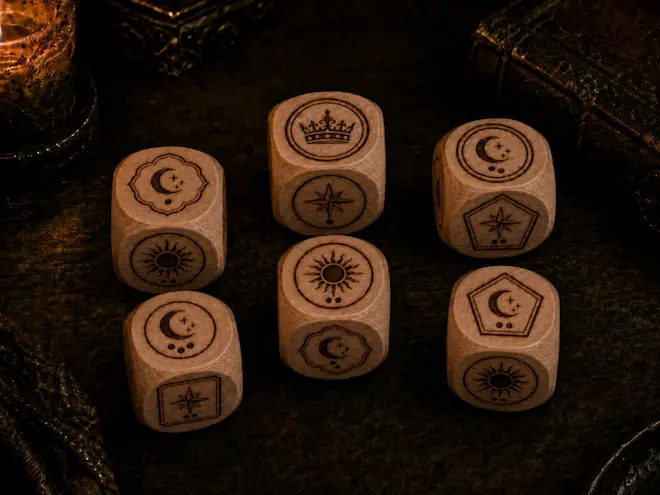
Each Astral die face has a Shape: Sun, Moon, Star, Crown.
Sun, Moon, and Star shapes also have:
The Halo Oracle has four Halo faces—Pentagon, Round, Square, and Wavy—and two Crown faces.
The Dots Oracle has faces showing 1, 2, 3, and 4 Dots, and two Crown faces.
The Oracle Halo and Oracle Dots currently shown together form the Oracle Stand.
Choose a turn timer before the game begins, from 10 seconds to 2 minutes.
1. Each player rolls the Dots Oracle. The player with the most dots starts. Crowns count as 0 dots. Tied players reroll until one tied player wins.
The first player rolls both Oracle dice together. If either shows Crown, reroll both without resolving Crown effects. Continue until the Halo Oracle shows a Halo and the Dots Oracle shows a Dot count. Together they establish the first Oracle Stand.
2. Divide the 48 Astral dice as evenly as possible among all players. Everyone rolls their dice into the middle at the same time. This creates the Celestial Pool. All dice in the Celestial Pool and in Assembly Rows are public.
3. Play clockwise.
Start the timer and choose 1 action: Claim, Recast, Shift, Parley, or Stir the Pool:
Your Assembly Row holds up to 4 dice. If it has 4 dice, you cannot Claim; choose Recast, Shift, Parley, or Stir the Pool instead. Whenever you take a die from the Celestial Pool, keep its top face unchanged. You may orient it any way, but once it touches your Assembly Row, its direction is fixed until a Shift changes it. Parley moves a die without changing that top face orientation.
After your action, if your Assembly Row has 4 dice, check for an Astral Sign. If you call a valid Astral Sign, stop the timer, score it, and complete its Oracle sequence. Then you may Sacrifice 1 point. Your turn ends only after your action, any Astral Sign and Oracle sequence, and your Sacrifice choice. If time runs out first, resolve Sabotage and do not check for an Astral Sign.
An Astral Sign is exactly 4 dice in your Assembly Row. It must include at least 1 Crown and cannot include 4 Crowns.
A valid Astral Sign must match one of these patterns:
For a normal Astral Sign check, read only the four top faces. When those top faces form a valid Astral Sign, you may score it at the end of your turn by saying, “Astral Sign!” This immediately stops the timer. Side faces count only when another player’s Shift or Oracle resolution triggers Blessing in Disguise.
To score, move all non-Crowns to your score pile, reroll all Crowns into the Pool, and empty your Row. Score-pile dice are out of play unless moved by Sacrifice, penalties, False Signs, a two-Crown Omen reading, Blessing in Disguise, or tiebreakers.
After scoring, read the Oracle as described in Rolling Dice. A normal Omen rolls both Oracle dice. A Seal keeps the Halo Oracle fixed and rolls only the Dots Oracle. An Eclipse keeps the Dots Oracle fixed and rolls only the Halo Oracle.
After a Perfect Omen, either read the Oracle normally or set both Oracle dice directly to any chosen non-Crown faces. Direct setting causes no Crown effects. The chosen Stand becomes current and resolves every Blessing it creates. No Assembly Row dice return.
If the player chooses to roll, resolve every Crown effect and continue until the first Crownless Stand appears. That Stand must be accepted; the player cannot switch back to setting it by hand. A Perfect Omen scores the same 1 point as any Omen.
If you call an Astral Sign and it is not valid, it is a False Sign: lose 1 point and end your turn. To lose 1 point, take 1 die from your score pile and roll it into the Celestial Pool. If your score pile is empty, you choose 1 die from your Assembly Row instead. If both are empty, there is no penalty.
At the end of your turn, after your action and any scored Astral Sign and Oracle sequence, you may Sacrifice 1 point. To Sacrifice, choose 1 die from your score pile and roll it into the Celestial Pool. Sacrifice is not an action. You may do it in addition to your turn action.
If your timer reaches zero before your turn is finished, the player to your right chooses 1 die from your Assembly Row and rerolls it into the Celestial Pool.
If your Assembly Row is empty, nothing happens.
After Sabotage, your turn ends. Do not check for an Astral Sign.
If your Shift or an Oracle resolution during your turn gives an opponent a valid Astral Sign on either the four top faces or one common visible side of all four dice, they may immediately call and score it as a Blessing in Disguise.
For a side Sign, all four faces must point in the same table direction. Do not combine different sides or inspect bottom faces. Identify the direction before touching the dice, and use the faces in that view to determine which dice are Crowns and which dice score. Side Signs apply only to Blessing in Disguise caused by another player’s Shift or Oracle resolution; normal turn checks, including after your own Shift or a Parley, use top faces only.
If more than one view is valid, the blessed player chooses 1 Sign to score. If an Oracle Stand creates several Blessings, resolve them clockwise beginning with the next player after the Oracle reader.
After scoring, they take two dice from your score pile and add them to their own. If you have fewer than two, they take as many as possible. If your score pile is empty, no additional dice are taken. If another player’s top faces form an Astral Sign because of a Parley, they may call it only on their own turn.
When a Blessing scores any Sign, queue that Sign’s Oracle reading. Finish every Blessing awakened by the current Stand. Then, in the same order, each scorer resolves their Sign’s reading to completion and pays for any Blessings it creates.
Players may view public dice from any angle, including by moving around the table, but may not block another player’s view or delay the active player. Do not touch, lift, rotate, separate, inspect, or move any die unless a rule allows it. Blocked dice stay as they are until moved legally.
Illegal handling uses the same 1-point payment as a False Sign. If the active player is the offender, their turn ends. If an inactive player is the offender, the active turn continues. Any changed face or position stands; do not reset the game.
Whenever dice are rolled, roll them into the Celestial Pool. If a rolled die bumps another die and changes its face, the resulting face stands. Bumping dice is allowed. If a die leaves the table, lands cocked, lands on another die, or otherwise fails to land properly in the Celestial Pool, reroll it immediately.
Each Sign reads the Oracle differently after scoring:
The fixed die remains part of every result. Judge both Oracle dice together:
Resolve Crown effects on every roll and continue until both Oracle dice show non-Crown faces. Oracle dice are not Astral dice and never enter the Pool, an Assembly Row, or a Sign.
The end of the game is triggered when the Celestial Pool has dice equal to or below the End Limit: 2 players: 12 dice, 3 players: 8 dice, and 4 to 8 players: 4 dice. Finish the current turn, including its action, Astral Sign and any Oracle sequence, penalty, Sacrifice, or timeout effect. Then continue clockwise until the player immediately to the starting player’s right finishes their turn. If that player triggered the end, the round is already complete. The trigger remains even if dice later return to the Pool. After the round ends, every player with 4 dice in their Assembly Row checks for one final Astral Sign.
Final checks are simultaneous: eligible players inspect the current Stand and declare 1 valid top-face Sign before any is scored. Those declarations remain valid if the Stand later changes. Score declared Signs clockwise from the starting player. Queue each final Sign’s Oracle reading and resolve the readings after all declared Signs have scored, in the same order.
Each scored die is worth 1 point. The player with the most points wins.
Moving a scored die between players changes their point totals, but it does not change who originally scored an Eclipse or Seal.
Tiebreakers: The player that scored the most Eclipses wins. If still tied, the player that scored the most Seals wins. If still tied, the player with the fewest dice remaining in Assembly Row wins. If still tied, each tied player rolls the Dots Oracle. Most dots wins; Crowns count as zero. If still tied, reroll.
Rules Appendix
The official rules above are the law of the table. These notes are optional commentary for players who want to study how strong decisions emerge inside that law.
Build Omen, Seal, or Eclipse before the Oracle Stand or your rivals change the route.
Crowns authorize Signs. Every Oracle reading may return matching Row dice or awaken Blessings. Only Omen may also take scored dice.
The timer is not only pressure. It is a weapon. A fast turn, a Stir, or a purposeful Parley can force rivals to think under sand.
The strongest players do not chase one perfect plan.
They build Shape and Dots families, read both parts of the Oracle Stand, pivot between Signs, deny the market, and close with points and tiebreakers.
Know whether you are building power or buying time.
Every turn in Astral Assembly asks a question that is not written in the rules:
Are you building toward the strongest possible score, or are you taking a smaller score before the table changes?
This is the difference between Engine and Rush.
The Engine plan builds toward Eclipse: 1 Crown and 3 same-Shape, same-Dot non-Crowns using the three non-Oracle Halos and Dots different from the Oracle Dots.
Eclipse also matters after scoring because it is the first tiebreaker. A completed Eclipse is not only 3 points. It is also tiebreaker pressure. If two players finish tied on points, the player with more Eclipses is ahead before Seals, row size, or final die rolls matter.
Its Oracle reading moves only Halo while Dots stays fixed. A Crown calls Row dice bearing those fixed Dots; a Crownless result may awaken Blessings under the new Halo.
Eclipse is a family plan: same Shape and Dots, the three safe Halos, and a Dot value outside the Oracle Stand.
The Rush plan takes a faster Omen matching either Oracle value or a Seal whose exact twins do not match both.
A beginner asks:
Can I make a Sign?
An expert asks:
Is this Sign worth the time it will cost me?
Builds toward Eclipse.
Highest scoring ceiling.
Needs clean structure.
Best early when the Pool gives time.
Scores sooner.
Uses a live Omen match or legal exact-twin Seal.
Best late or when tempo matters.
Eclipse is the most valuable Sign, but it is also the most demanding.
A player who always chases Eclipse may build elegant rows that never score. They wait for the perfect third non-Crown. They protect a beautiful idea. They imagine the 3 points they deserve. Then another player scores Seal twice, or the Celestial Pool shifts, or the game ends before the plan becomes real.
Every completed Sign also reads the Oracle. Seal may change only Dots, Eclipse may change only Halo, and Omen may change both. Perfect Omen may choose the next Stand directly.
A Crown-heavy row is live when its non-Crown matches the Oracle Halo, Oracle Dots, or both.
The strongest player is not loyal to Eclipse.
The strongest player is not loyal to Omen.
The strongest player is loyal to timing.
Near the end, Omen guarantees 1 point. A normal reading may take scored dice more than once, while Perfect Omen may control the Stand directly.
The table decides what kind of player you must become.
The Engine plan begins with structure.
A clean Eclipse pair means the dice agree in Shape and Dots while leaving room for different non-Oracle Halos. If the next die can continue that family with an unused non-Oracle Halo, the row becomes dangerous.
Example Engine setup
This row is promising only when its shared Dots differ from Oracle Dots and a third non-Crown can complete the three non-Oracle Halos.
You are not waiting for any useful die. You are waiting for a narrow family: the same Shape, the same Dot value, and a Halo you do not already have.
A good engine keeps its shared Dots safe and its missing Halo visible.
A bad Engine plan waits for a miracle.
A good Engine plan creates several possible futures.
Engine is strongest when the Pool gives you room to breathe.
If your row has 1 Crown and 2 clean non-Crowns, the table should begin to worry. You are not scoring yet, but you are building toward the most valuable Sign.
The most dangerous phrase in Astral Assembly is: one more turn.
Sometimes one more turn is correct. Often, it is vanity wearing a strategist’s mask.
The Rush plan is not mindless speed. It is the decision to take immediate value because waiting is worse.
Rush usually appears as an Omen matching either Oracle value or a Seal built from exact twins that avoid a double match.
After Omen, Crown readings create volatility. Perfect Omen may avoid it by setting a chosen Stand, or accept it by rolling normally.
Rush example: Omen, assuming Pentagon matches the Oracle Halo or 2 matches Oracle Dots
Rush is not about being impatient. Rush is about understanding that points already scored are safer than points still imagined.
A good Rush feels practical, not desperate.
The table is changing. I will take what can be taken.
Rush is weak when it becomes your default. If you take Omen early just because it is available, you may clear your row for 1 point while the Oracle gives you no further advantage and another player quietly builds toward Eclipse.
Rush is also weak when it ignores the board. If you can complete Eclipse soon, taking Omen may throw away a winning position.
Do not rush because you are nervous. Rush because the table, score, Pool, and timer all say that waiting is more dangerous.
Your Assembly Row contains: Crown; Sun, Round, 2; Sun, Square, 2. This is a good Engine position.
Continue only if the shared Dots differ from Oracle Dots and a third safe Halo is available.
If the safe Eclipse finisher is absent but a legal exact twin and second Crown are visible, the table may be offering Seal.
You may not have a clean Eclipse soon. But if you can create exact twins with a second Crown, Seal may become available. You may need to stop dreaming about 3 points and take 2.
Seal can also matter in tied-score games. Seal scores 2 points, and if Eclipse counts are tied, Seals are the next tiebreaker. If the final score may be close, a Seal can be worth more than its raw points suggest.
With 3 Crowns, any non-Crown matching either Oracle value completes Omen. Near the End Limit, that broader route may matter more than a perfect Eclipse.
Scout Eclipse.
Test the Seal.
Rush Omen when the Stand agrees.
Beginners often think the highest-value Sign is always the best plan. That is false.
Eclipse is the best completed Sign, but it is not always the best decision. A 3-point Sign that never scores is worth nothing. A 2-point Seal scored at the right moment can win the table. A timely Omen at the edge of the endgame can be more valuable than a perfect Eclipse that never arrives.
The beginner sees the reward.
The expert sees the cost of waiting.
Engine players look patient, but they become obvious.
If you sit with 1 Crown and 2 clean non-Crowns, opponents will begin scanning the Pool for your finisher. They may Claim it before you. They may Stir it away. They may Shift your row. They may Parley to extract value from you.
A Rush plan can be harder to stop because it gives the table less time to react. Sometimes the best strategy is not the one with the highest ceiling. It is the one your opponents notice too late.
Can I complete an Oracle-safe Eclipse?
Are my Seal twins legal?
Does Omen match one value or both?
If Perfect, should I set the Stand or accept a reading?
When an Eclipse line duplicates a Halo, the failed 3-point plan may become a 2-point seal.
In Astral Assembly, ambition is useful only while it remains alive.
Many players begin correctly. They build toward Eclipse, the richest Sign in the game. They claim 1 Crown. They collect clean non-Crowns. They watch the Celestial Pool for the perfect third piece.
Then the table refuses them.
This is where weaker players become stubborn. The expert does something different.
The expert notices when the row has stopped being an Eclipse line and has become a Seal line.
Seal is the bridge between patience and pressure. It scores 2 points, requires fewer non-Crowns than Eclipse, and can often be completed by claiming a second Crown at exactly the right moment.
A Seal Pivot is not surrender.
It is the art of turning unfinished ambition into scored authority.
A valid Seal contains 2 Crowns and 2 non-Crown dice.
The two non-Crown dice must be exact twins: same Shape, same Halo, and the same number of Dots.
Before pivoting, compare the pair with the Oracle Stand. If its Halo and Dots both match, it is not a Seal.
This makes Seal easier than Eclipse in one way and stricter in another. It is easier because it needs only 2 non-Crowns instead of 3. It is stricter because those 2 non-Crowns must match exactly.
A Seal does not ask for much, but it asks precisely.
Seal wants exact identity but rejects a double Oracle match. Eclipse wants Halo diversity and rejects both Oracle values.
Your non-Crowns are exact twins.
They avoid matching both Oracle values.
A second Crown is visible.
Tempo matters.
The twins match the full Oracle Stand.
Your Eclipse finisher is visible.
You need a 3-point swing.
The second Crown clogs your row.
Seal is the most important mid-game Sign.
Omen has the lowest guaranteed value and the widest Oracle route. Eclipse is powerful but narrow. Seal remains the practical center when its twins pass the Stand test.
A player who understands Seal can escape dead rows. They can recognize when an Eclipse plan has broken into a duplicate-Halo pattern. They can punish a Pool with visible Crowns. They can score before opponents expect them to.
Seal also matters beyond its 2 points. If players tie on score and Eclipses, the player with more Seals wins the next tiebreaker. A Seal is not just a smaller score; it can become the deciding record of the game.
One turn, a player seems to have an unfinished Eclipse engine.
The next, the Stand allows their twins and a second Crown scores Seal.
That is the strength of the pivot. It changes the question from “How do I complete the perfect Sign?” to “What is the best Sign the table is offering?”
The cleanest Seal Pivot begins when an unfinished row already holds exact-twin non-Crowns.
Seal Pivot: before and after
Before the pivot
Completed Seal
The Round-2 twins become Seal with a second Crown only when the Oracle Stand is not Round-2.
Look for Seal when your row has 1 Crown and 2 identical non-Crowns that do not match both Oracle values.
The moment you see this structure, your eyes should start checking the Pool for a Crown.
Seal is especially strong when the table thinks you are still chasing Eclipse, but your duplicate Halo has quietly created a different threat.
Seal is better than Eclipse when Eclipse is imaginary, especially after your row has duplicated a Halo.
A real Seal is worth more than a theoretical Eclipse. If the Pool does not contain a useful third non-Crown, your 3-point dream may only be decoration.
Seal is also better when tempo matters. If another player is one turn away from scoring Eclipse, taking Seal immediately may prevent you from falling too far behind. If the game is near the end, 2 immediate points may matter more than 3 points later.
It is also better when a Seal may protect a tiebreaker position. If you cannot catch someone on Eclipses, banking Seals may be the next-best way to win a tied game.
Seal is not the biggest score. It is the score that often arrives in time.
Do not pivot to Seal automatically. Seal is wrong when your Eclipse finisher is visible and likely to remain available until your turn.
Seal is wrong when claiming a second Crown lets an opponent take an even better die. Seal is wrong when your non-Crowns are not exact twins. Seal is wrong when you are far behind and need a larger swing, especially if Eclipse is still realistic.
The point is not to prefer Seal over Eclipse. The point is to know when Eclipse has stopped being real.
Your Assembly Row contains Crown; Sun, Round, 2; Sun, Round, 2. The Pool contains Crown; Star, Pentagon, 4; Moon, Wavy, 1; Sun, Square, 3.
You were hoping for Eclipse, but the two Suns duplicate the Round Halo. That means the row is not a clean Eclipse line. The Crown is available.
If Round and 2 do not together equal the Oracle Stand, claiming the Crown gives an immediate 2-point Seal. If both match, the pair must wait for the Stand to change.
Your Assembly Row contains Crown; Sun, Round, 1; Sun, Square, 1. The Pool contains Sun, Pentagon, 1 and Crown.
Here, the Sun, Pentagon, 1 may continue a strong Eclipse path with the same Shape and Dots and an unused Halo. If you claim the Crown instead, you do not have Seal, because your non-Crowns are not exact twins.
Not a Seal: the non-Crowns are not exact twins.
You have not pivoted. You have clogged your row. Seal Pivot is not “claim a second Crown.” Seal Pivot is “claim a second Crown when your non-Crowns already satisfy Seal.”
Matching Dots matter, but they are not enough for Seal. When choosing your early non-Crowns, watch Shape, Halo, and Dots together.
Sun, Round, 2 twins support Seal unless Round and 2 are both on the Oracle Stand.
Sun, Round, 2 beside Sun, Square, 2 supports Eclipse only when 2 differs from Oracle Dots and both Halos are safe.
Exact twins whisper Seal.
Same Shape and Dots with different non-Oracle Halos whisper Eclipse.
The Pool decides which whisper becomes a command.
A strong Seal setup should make other players nervous. If you have Crown; Sun, Round, 2; Sun, Round, 2, then every Crown in the Pool becomes dangerous.
Opponents may Claim it, Stir it away, Shift your row, or score another Sign. The reading after that score may call both twins away: Seal calls by the fixed Halo, Eclipse by the fixed Dots, and Omen may call either. The settled Stand may also legalize or forbid the pair.
A visible Seal threat can force opponents to waste actions defending against you. That is value, even before points.
Seal becomes especially strong when the Pool has extra Crowns. If the Pool is Crown-rich, players may assume Crowns are easy to get, but a Seal player can turn that abundance into immediate points.
The important question is: who can use the next Crown fastest?
If the answer is you, Seal is live. If the answer is an opponent, you may need to deny them first. Crown supply is never neutral. Every Crown either opens a door for you or for someone else.
Scoring a Seal does more than give 2 points. It also empties your Assembly Row.
The two non-Crowns go to your score pile. The two Crowns return to the Celestial Pool and are rerolled. Your row becomes empty.
Then Dots is read while Halo stays fixed. If Dots shows Crown, the fixed Halo calls every matching Row die before Dots is rolled again. A Crownless result changes only Dots and may awaken Blessings.
This reset has strategic value. It frees you from a row that may have become too obvious or too fragile. It lets you begin another plan. It also reduces your row size if score, Eclipses, and Seals remain tied.
A scored Seal is points and an empty row.
Beginners often miss Seal because they look for more Crowns for Omen, more non-Crowns for Eclipse, and obvious completed Signs.
They do not notice that two exact-twin non-Crowns are already a Seal structure.
The beginner sees: “I have only three dice.”
The expert sees: “I am one Crown away from 2 points.”
To pivot into Seal, ask:
Same Shape, Halo, and Dots?
Second Crown available?
Does the pair avoid matching both Oracle values?
If the Crown is available and your duplicate-Halo row is not about to become a real Eclipse line, take the Seal.
Crowns do not score, but they decide who can.
The first lesson of Astral Assembly is that Crowns do not score.
The deeper lesson is that no one scores without them.
Every valid Astral Sign needs at least 1 Crown. Omen needs 3. Seal needs 2. Eclipse needs 1. A row with perfect Suns, Moons, Stars, Halos, and Dots means nothing if it has no Crown.
They are not points.
They are permission.
Crown Starvation is the strategy of claiming or holding Crowns when they create a real scoring path for you or deny a real scoring path from someone else.
You are not collecting treasure. You are controlling access to the throne.
Crown Starvation means using Crowns as one strategic bottleneck. Since every Astral Sign requires at least 1 Crown, Crowns open the door to scoring, but the Sign patterns also demand exact non-crown structure.
When you Claim a useful Crown, that door closes for everyone else and opens for you. This matters most when Crowns are scarce or when a player already has the non-Crown dice needed for a live Sign.
Crown Starvation is not always obvious. Sometimes it looks like you are simply building your own row. But if your Claim also prevents the next player from completing a Sign, you have gained twice: you improved your position and weakened theirs.
That is efficient play.
Crowns behave differently from non-Crowns. Non-Crown dice become points when scored. They leave play and sit in the score pile.
Crowns return to the Celestial Pool when a Sign scores, but an Oracle Crown never calls a Crown face from an Assembly Row. One Crown may call away matching non-Crowns. Two Crowns, possible only when Omen rolls both Oracle dice, reach into a score pile instead.
This means Crowns are temporary power. They move through the game like offices, titles, and favors at court. A player may hold them for a while, but they rarely keep them forever.
The key question is not: “How many Crowns can I get?”
The real question is: “Who can use the next Crown best?”
If the answer is you, Claim it. If the answer is an opponent, consider denying it. If the answer is no one, it may be safe to leave it.
Judge Crown supply by the Pool and Rows. Omen needs one Oracle match, Seal needs legal exact twins, and Eclipse must avoid both Oracle values. A Crown matters only when it connects to one of those routes.
Cannot score yet.
Best Eclipse setup, especially with matching Shape and Dots.
Strong exact-twin Seal setup if the matching non-Crowns are available.
Omen setup when one non-Crown can match Oracle Halo or Dots.
Invalid and dangerous.
With 1 Crown, seek an Eclipse family avoiding Oracle Halo and Dots. With 2, seek exact twins that do not match both. With 3, any non-Crown matching either Oracle value can complete Omen. Four Crowns remain invalid.
A 3-Crown row is dangerous bait. Any Sign may settle a Stand that awakens its Omen as a Blessing, while a Crown result may call the lone non-Crown away before that Stand appears.
The Pool has few Crowns.
Your Crown also denies a live Sign.
Your exact twins pass the Stand test.
You can convert soon.
You need Eclipse points.
Your 3-Crown row matches neither Oracle value.
Your row becomes clogged.
You pass up an obvious finisher.
You are blocking your own Eclipse tiebreaker chances.
Two Crowns can create pressure in both directions. They help you when they point toward an exact-twin Seal. They hurt opponents when the table is short on usable Crowns.
A player with 2 Crowns and one useful non-Crown is not finished, but they are dangerous only if an exact twin exists or can be created. A player with 2 Crowns and two exact-twin non-Crowns is immediately threatening Seal.
Crown Starvation pressure
Assembly Row
Celestial Pool
The table must respond. They may Claim the exact twin you need, Stir the Pool, Shift your row, or rush their own score before you finish. All of that is value.
A good Crown Starvation position does not just score. It changes what everyone else is forced to think about.
Crown Starvation is strongest when it does two things at once. A bad Crown Claim only helps you a little. A good Crown Claim helps you and hurts the table.
The beginner sees a Crown and thinks: “I should take it because Crowns are important.”
The expert asks: “What does taking this Crown do to the table?”
If the answer is “not much,” it may not be worth your action.
The Pool contains Crown, Crown, Moon Pentagon 1, Star Wavy 3, and Moon Square 4. Your Assembly Row contains Moon, Pentagon, 1. No opponent has a Crown yet.
You Claim a Crown. On your next turn, another Crown is still available. You Claim it. Now your row is Crown, Crown, Moon, Pentagon, 1.
This is pressure only if the matching Moon pair does not equal both Oracle values.
You have not scored yet, but you have slowed the court.
Your Assembly Row contains Crown, Crown, Crown. None of the available non-Crowns matches either Oracle value, so you Claim a fourth Crown.
Invalid: four Crowns cannot form an Astral Sign.
This is not a valid Sign. It cannot score. You cannot Claim more dice because your row is full. You must Recast, Shift, Parley, or Stir to escape.
You did not starve the table. You trapped yourself.
Seal is the reason Crown Starvation becomes more than denial. A player with 2 Crowns is always asking whether two non-Crowns can match exactly: same Shape, same Dots, and same Halo.
A Sun, Round, 2 is not just a die. Another Sun, Round, 2 in the Pool may become the exact piece that turns your Crown control into 2 points.
With 2 Crowns, exact matches become more valuable. You are asking whether the table is offering Seal.
Three Crowns point toward Omen when the fourth die matches the Oracle Halo, Oracle Dots, or both.
Be careful: Omen and dice taken after two Crowns add no Eclipse or Seal tiebreaker strength.
If you already have 3 Crowns, do not pretend you are building a rich long-term structure. You are either preparing to score Omen or you need to convert the row quickly, before another reading breaks the route apart.
A Crown is authority.
Three Crowns with no plan become bureaucracy.
The tiebreakers make Crown choices more important. Eclipses beat Seals in ties, and Seals beat leftover row position. Omens score points, but they do not help either of the first two tiebreakers.
This means 3-Crown Omen play can protect a lead, but it can also leave you fragile if the score is tied. A 1-Crown Eclipse plan may be better when the game looks close. A 2-Crown Seal plan is useful, but it sits below Eclipse in tie strength.
Starve the table, but do not starve your own tiebreakers.
In a 2-player game, Crown Starvation is direct and brutal. Every Crown you take is denied to exactly one opponent.
In a 3-player game, Crown Starvation becomes political. Denying a Crown from one opponent may accidentally help another.
With 4 to 8 players, Crown Starvation becomes harder to control. Visible Crowns may not survive a full circuit of the table, so turn-order denial matters more than hoarding.
The larger the table, the more Starvation becomes temporary. Use the window before it closes.
If another player is starving Crowns, do not simply complain about bad luck. Respond.
Crown Starvation is strong, but it is not unbeatable. It creates pressure. Pressure invites response.
Every Crown you hold occupies a slot in your Assembly Row. Your row can hold only 4 dice. That means every Crown reduces the number of non-Crown dice you can hold.
With 1 Crown, you can still hold 3 scoring dice for Eclipse. With 2 Crowns, you can hold only 2 scoring dice for Seal. With 3 Crowns, you can hold only 1 scoring die for Omen.
The more Crowns you hold, the lower your scoring ceiling becomes. Oracle Crowns cannot free those slots, so Starvation must eventually become conversion through your own play.
Also watch the score piles. Non-Crown dice that score leave the game, so exact twins and Eclipse families can become harder to find.
Control without conversion is vanity.
Beginners often make one of two opposite mistakes. Some ignore Crowns because Crowns do not score. Others overvalue Crowns and collect too many.
Both mistakes come from misunderstanding the same truth: Crowns are not points, but points need Crowns.
The expert does not worship Crowns.
The expert uses them.
Before claiming a Crown, ask:
Does it help my Sign?
Does it deny an opponent?
Do I still have room for scoring dice?
Can I convert it soon?
If I am holding 3 Crowns, can I reach a die matching either Oracle value?
If the game is close, am I giving up an Eclipse or Seal tiebreaker?
If the Crown gives you a path and blocks someone else, take it.
If the Crown fills your row without a plan, leave it.
Every die in your row should have a job.
A weak player fills their Assembly Row.
A strong player builds it.
This is the difference between collecting dice and designing a row. Your Assembly Row has only four spaces. Every space matters. Every die you Claim changes what Signs are possible, what future dice become useful, and how easily opponents can read or disrupt your plan.
A random row may look promising because it contains beautiful dice. A clean row is promising because its dice cooperate.
Clean Row Architecture means building relationships first, then checking how the Oracle Stand opens or closes each Sign.
The novice asks:
Is this die good?
The expert asks:
Is this die good with the dice I already have?
A clean row is a row that keeps scoring paths open.
Seal wants exact twins that avoid matching both Oracle values. Eclipse wants same Shape and Dots while avoiding both. Omen wants one die matching either.
A die is useful only in relation to its row and the current Stand.
Clean architecture is the art of choosing dice that leave a real scoring future open.
Omen is the Crown-heavy path. Shape does not matter; matching the Oracle Halo, Oracle Dots, or both does.
This gives a 3-Crown row more finishers. Normal Omen accepts an Oracle reading; Perfect Omen may choose direct Stand control instead.
Omen needs one answer to a two-part question.
Most failed rows fail before the player notices. A player Claims a useful-looking die, then another, then a Crown, then a fourth die. Only at the moment of checking do they discover the row cannot score because the non-Crowns do not form exact twins for Seal or a same-Shape, same-Dot, all-different non-Oracle-Halo line for Eclipse.
By then, the row is full. Now the player must spend actions fixing what should never have been built.
Every action spent repairing a bad row is an action not spent scoring, denying, or pressuring opponents. Recast can fix mistakes, but expert players prefer not to create those mistakes in the first place.
A clean row does not guarantee a Sign.
It guarantees that your next useful die remains useful.
The strongest foundation is exact twins that pass the Seal test, an Oracle-safe Eclipse family, or two Crowns beside a die matching either Oracle value.
Clean Eclipse foundation
This foundation supports Eclipse only while its Dots differ from Oracle Dots and its Halos can become the three non-Oracle Halos.
Exact twins point toward Seal only while they avoid matching both Oracle values.
Before you trust a foundation, ask:
Do exact twins avoid matching both Oracle values?
Does an Eclipse family avoid Oracle Halo and Dots?
Does an Omen die match either value?
If the answers point to a real Sign, you have architecture. If not, you have decoration.
A wrong Shape can quietly destroy your scoring path. Same Shape is required among the non-Crowns for both Seal and Eclipse.
Dirty row: wrong Shape for the chosen route.
At first glance, mixed Shapes may look varied and useful. But Seal and Eclipse both demand sameness of Shape among their non-Crowns. One wrong Shape must eventually be Recast, Shifted, swapped, or ignored.
Variety of Shape is not a scoring virtue.
A repeated Halo is useful for Seal if the dice are exact twins, but it blocks Eclipse unless the row changes path.
Route warning: repeated Halo blocks Eclipse but may support Seal.
Repeated Halo supports Seal only if the twins avoid a double Stand match. Eclipse needs the three non-Oracle Halos and non-Oracle Dots.
The Halo is not decoration.
It tells you whether the row wants Seal, Eclipse, or Omen.
Dots do not choose the route by themselves. Seal and Eclipse both need matching Dots across their non-Crowns. Your Shape and Dot value form the anchor. Your Halos and Crown count decide the route.
Sun 2 can support Eclipse only when 2 is not Oracle Dots and its Halos exclude Oracle Halo. Sun Round 2 twins support Seal unless Round and 2 together equal the Stand.
Exact twins point toward Seal.
Same Shape and Dots with different non-Oracle Halos point toward Eclipse.
If the Dots do not match across the non-Crowns, Seal and Eclipse both fail.
A strong early Assembly Row often looks like this: Crown, Non-Crown A, Non-Crown B, Empty slot.
A Crown-heavy Omen row is clean when its non-Crown matches either Oracle value.
Crowns create pressure. Non-Crowns give direction. The empty slot preserves flexibility.
Crown, Sun Round 2, Sun Square 2 says: “I am building toward Eclipse. I need a Sun with a third Halo and 2 Dots.” Crown, Sun Round 2, Sun Round 2 says: “I can pivot to Seal if I find a second Crown.”
Crown, Crown, Sun Round 2 is one Crown from Omen whenever Round matches Oracle Halo or 2 matches Oracle Dots.
The best early rows say something clearly. A row that says nothing will usually score nothing.
Crown
Sun, Round, 2
Sun, Square, 2
Empty slot
Why it works: Same Shape. Same Dots. Halos can become all different for Eclipse.
Crown
Sun, Round, 1
Sun, Square, 3
Empty slot
Why it fails: The Dots do not match. The row needs repair before it can become Seal or Eclipse.
The point of clean architecture is not to lock yourself into one plan too early. The point is to create useful choices.
Crown, Sun Round 2, Sun Square 2 has an Eclipse future only if 2 and both Halos are Oracle-safe. Exact Round-2 twins have a Seal future unless they match the full Stand.
Now consider Crown, Sun Round 2, Moon Square 2. It looks similar, but the wrong Shape blocks both Seal and Eclipse cooperation.
Beginners play the top; experts plan through the sides. A row has one top view but four lateral views, and careful orientation can preserve a future Shift route or concealed Blessing. The side faces are not secret, only less likely to command the table’s attention.
A clean row can pivot.
A dirty row must be repaired.
Eclipse scores three and wins the first tiebreaker; Seal scores two and wins the second. Omen scores one, but a normal reading may take scored dice more than once and Perfect Omen may set the Stand. Neither adds Eclipse or Seal tiebreaker strength.
Clean Row Architecture changes how you scan the Celestial Pool. A beginner scans for attractive dice. An expert scans for compatible dice.
If your row holds Sun-2 dice, first verify that 2 differs from Oracle Dots, then seek the missing safe Halo.
That clear search makes you faster under the timer and helps you identify when the Pool has stopped helping you.
Also scan both Oracle values. A die matching either may complete a 3-Crown Omen.
Read every opponent’s structure against the same Stand: missing Eclipse Halos matter only with safe Dots, while 3-Crown rows can finish through Halo or Dots.
You are not only reading your row. You are reading every row as unfinished architecture.
Shift makes architecture unstable. Your row may be clean at this moment, but a Shift can turn one die into the wrong Shape, the wrong Halo for your route, the wrong Dot value, or an unexpected Crown.
When Shifting your own row, all dice in your Assembly Row turn one step in the same chosen table direction. This can save a broken row, but it can also ruin a clean one.
When Shifting an opponent, you turn one die. A Shift or Crownless Oracle Stand can complete their Sign, so inspect the top and every shared visible side before play continues.
Every score may settle a Stand that activates or invalidates Signs and awards Blessings. Before it settles, a Seal Crown calls the fixed Halo, an Eclipse Crown calls the fixed Dots, and an Omen Crown may call either.
The risk follows the pattern: a Dots call can sweep an Eclipse family, either call can take both Seal twins, and a single match can strip the lone die from a waiting Omen.
An Oracle bait succeeds only when the scored Sign can move the part blocking it. Seal may clear Dots, Eclipse may clear Halo, and Omen may clear either or both. A Row blocked by both parts needs Omen or more than one reading.
Build cleanly, but count who can call the Oracle before your structure scores.
Recast is the tool that repairs bad architecture. Use Recast when a die has lost its job.
Do not Recast randomly. Recast the die that prevents the largest number of future Signs.
Parley is often strongest when you can explain architecture without revealing too much. You might offer: “That die helps my row, but this one gives you a cleaner pair.”
You can also use Parley to escape bad architecture. But Parley has a cost: it reveals what you care about. A good Parley gives you structure without announcing your entire plan.
Your row: Crown; Sun, Round, 2; Sun, Square, 2. The Pool contains Sun, Pentagon, 2; Star, Round, 4; Sun, Wavy, 2; Crown.
A third Sun-2 completes Eclipse only if 2 differs from Oracle Dots and the three Halos exclude Oracle Halo.
The Star, Round, 4 has the wrong Shape and Dots. The expert asks whether Shape, Dots, and Halo route all agree.
Your row: Crown; Sun, Round, 2; Sun, Round, 2. The Pool contains Crown; Star, Pentagon, 4; Moon, Wavy, 2.
The best Claim may be Crown only if the exact twins do not match both Oracle values.
The clean pair creates the pivot. Without clean architecture, the pivot would not exist.
Your row has Crown, Crown, Moon Round 4. It is one Crown from Omen whenever Round equals Oracle Halo or 4 equals Oracle Dots.
Your row: Crown; Sun, Round, 1; Sun, Square, 3. This row has matching Shape but broken Dots.
You might feel close because both non-Crowns are Suns, but Seal and Eclipse both require the non-Crowns to share Dots. This row needs repair before it can become a Sign.
Good options include Recasting the wrong-dot die, using Parley for a matching Sun, Shifting your own row if you are willing to transform the entire row, or Stirring the Pool if the next player is more dangerous.
A broken foundation does not become stronger by adding another floor.
Beginners overvalue the fourth die. They think: “I need to fill my row.”
But filling the row is not the goal. Building a valid Sign is the goal. A bad fourth die can be worse than an empty slot because it fills your row, blocks Claim, and forces you into repair.
An empty slot is possibility.
A bad die is obligation.
Before claiming a non-Crown, ask:
Which Sign does it support?
Does Seal avoid a double Stand match?
Does Eclipse avoid both Oracle values?
Does Omen match either?
Will it survive a change of plan?
If the die answers well, Claim it. If it only looks good alone, leave it.
Return certainty to chaos, but only with purpose.
Recast is one of the most misunderstood actions in Astral Assembly.
A beginner uses Recast when they do not know what else to do. An expert uses Recast when they know exactly what must be removed.
Recast is not a panic button.
Recast is not a pass.
Recast is not a way to empty your row.
Recast is surgery.
You take one die from your Assembly Row, return it to the Celestial Pool, reroll it, then take one die from the Pool into your row. Your row size does not change.
The deeper lesson is that Recast changes the quality of your row without changing its size. It cuts out a die that does not serve the plan and replaces it with a die that gives the row direction again.
A Claim builds. A Shift transforms. A Stir disrupts. A Recast corrects.
The action has three parts: choose one die from your Assembly Row, return it to the Celestial Pool and reroll it, then take one die from the Celestial Pool and place it in your Assembly Row.
You may Recast only if you already have at least one die in your Assembly Row. This means Recast always asks two questions: which die must leave, and which die should replace it?
If you cannot answer both questions, you are not Recasting well. You are gambling in ceremonial clothing.
Exact repair
Problem row
Pool replacement
Repaired row
Astral Assembly punishes bad structure and bad Oracle relationships. A die may break the row, match both Stand values when Seal must not, or match either when Eclipse must avoid both.
Recast is how you remove the mistake without abandoning the entire row. If your row is almost good, Recast is often the cleanest repair.
It does not throw the whole table into chaos like Stir the Pool. It does not rely on hidden faces like Shift. It does not require another player’s agreement like Parley.
It is controlled correction.
Shape and Dots remain the spine of Seal and Eclipse, but the Oracle Stand decides whether that structure is currently legal.
Recast is strongest when it removes a die that does not belong to the lane.
First fix Shape and Dots. Then solve Halo.
Crown count decides how many dice the Sign itself scores: Omen 1, Seal 2, Eclipse 3. Only an Omen reading can show two Crowns and take an additional scored die.
This means Recasting a Crown is not just a repair. It can raise your ceiling. Turning an excess Crown into the right non-Crown die can move your row from Omen pressure toward Seal or Eclipse pressure.
The reverse can also be correct when 3 Crowns can reach a die matching either Oracle value.
Shape and Dots define the lane. Crown count defines the prize.
Recast does not reduce your row size. If your row has 4 dice before Recast, it will still have 4 dice after Recast. This means Recast does not directly help the row-size tiebreaker, which matters only after Eclipse count and Seal count are still tied.
Recast also does not directly reduce or increase the Celestial Pool count overall. One die enters the Pool, then one die leaves the Pool.
Do not use Recast because you think it empties your row. Do not use Recast because you think it pushes the End Limit by itself. Use Recast because one die in your row is wrong.
Row surgery.
Quality control.
A way to replace a bad die.
A way to convert one Sign plan into another.
A controlled answer when the Pool has a visible fix.
A pass.
A row reset.
A direct tiebreaker tool.
A direct Pool-count tool.
A reason to gamble without diagnosis.
Before you Recast, name the problem. Do not say, “My row is bad.” Say: “This die breaks my Shape and Dots family,” “This Halo repeats in my Eclipse route,” “This die is not an exact twin,” “This Crown is excess,” or “This fourth die does not complete any Sign.”
Before Recasting, name the wound:
Broken Shape and Dots family.
Repeated Eclipse Halo.
Missing Seal twin.
Excess Crown.
Bad fourth die.
No visible future.
If you cannot name the wound, you are not ready to cut.
A Recast without diagnosis is luck. A Recast with diagnosis is surgery.
The best die to Recast is usually the die that blocks the largest number of futures.
Because Eclipses win the first Sign tiebreaker, a Recast that preserves an Eclipse route is usually more valuable than a one-die Omen with no useful scored target.
The strongest Recasts do not merely repair. They convert. Conversion means changing the type of Sign your row is moving toward.
Before: Omen route
Pool replacement
After: Seal
Recast can turn an Omen route into a 2-point Seal only if the twins do not match both Oracle values.
You did not simply fix the row. You upgraded it.
Conversion is more opportunistic than automatic. Because Seal requires an exact twin, do not chase this upgrade unless the duplicate is already visible or your current Omen route is weak.
A Stand change can activate one route and close another. Recast the die that restores a legal relationship: one match for Omen, not both for Seal, neither for Eclipse.
A one-Crown reading may call a retained die from your Row whenever its Halo or Dots matches the other Oracle face.
Do not marry an Omen route. The Oracle can move the altar.
Recast is strongest when the Pool already contains the replacement you want. This gives the action control.
With 48 Astral dice in play, the Pool can contain more noise and more opportunity. Before Recasting blindly, scan for exact matches in Shape, Dots, and Halo, as well as missing Eclipse Halos.
A controlled Recast identifies the bad die, sees the replacement in the Pool, returns and rerolls the bad die, then claims the visible replacement. Your row improves immediately.
A desperate Recast throws a die back and hopes the reroll saves you. Sometimes desperation wins, but experts prefer control.
Recast resolves in order: you return and reroll one die, and only then claim one die from the Pool. Because the die you just rerolled is now sitting in the Pool, you are allowed to claim that same die back. That order turns Recast into a controlled fishing tool, not only a replacement.
This matters most for a die you need but whose top face is wrong. Claim it anyway to keep it off the table, then on a later Recast return it, reroll it, and read the result before you choose. If the reroll shows the face you wanted, take it and your row improves at once. If it does not, take the same die back regardless, keeping a rare Shape, Dot value, exact Seal twin, or missing Eclipse Halo under your control while you wait for a better roll.
This makes Recast a denial tool as much as a repair tool. It can also preserve a near-Sign or Oracle bait whose Halo and Dots relationships are waiting to change.
The cost is real. Rerolling can ruin a useful face, and a one-Crown reading may call the retained die back by its Halo or Dots. Fish only when the denial value is worth the gamble.
Recast does not only replace a die. It can hold one hostage while you wait for the face you need.
Sometimes Recast repairs your row while taking a legal twin, safe Eclipse piece, or Omen die matching either Oracle value away from an opponent.
The best actions in Astral Assembly often do two things: they help you and they hurt the table.
Recast is dangerous under low time because it requires two decisions: what leaves and what enters. If you begin your turn without knowing both, the timer will punish you.
Plan Recasts before your turn starts. During other players’ turns, scan your row and decide which die is expendable. Then scan the Pool for replacement candidates.
The Signs are strict. Blind Recast is weak. If you are not taking a visible replacement, changing Crown count with purpose, or removing a clearly off-lane die, you are probably just giving structure back to the Pool.
The sand is not patient with surgeons.
A full row creates pressure because you cannot Claim. If the row is valid, score it. If it is invalid, ask why.
A full row may fail through Crown count, broken structure, or the wrong relationship to either Oracle value.
Recast is often the best answer to a full invalid row because it keeps the useful parts and replaces the failure. But if the entire row is bad, Recast may be too small.
Surgery helps when the patient can be saved.
Best when your row has one bad die, the wrong Crown count, or a visible Pool replacement.
Best when the Pool has no answer and you accept hidden-face risk.
Best when another player has the die you need.
Best when the Pool helps opponents more than you.
Recast replaces a die with a Pool die. Shift transforms dice through hidden face geometry. Recast is better when the Pool has a visible replacement and you know exactly which die is bad. Shift is better when the Pool has no good replacement and you are willing to accept uncertainty.
Recast is the cleaner tool. Shift is the stranger one.
Recast does not require permission. Parley does. If the die you need is in another player’s Assembly Row, Parley may be your only direct way to get it. If the die you need is in the Pool, Recast is usually cleaner.
Use Recast when the answer is public. Use Parley when the answer is in another player’s hand.
Stir changes the shared market. Recast changes your row. Use Stir when the Pool helps others more than it helps you. Use Recast when your row contains a specific flaw and the Pool offers a fix.
Do not disturb the heavens when you only need to remove one bad stone from your own wall.
Your row is Crown; Sun, Round, 2; Sun, Round, 2; Sun, Square, 2. This row has repeated Round Halos while chasing Eclipse. The Pool contains Sun, Pentagon, 2; Crown; Sun, Wavy, 2.
Recast one Round-2 Sun for Pentagon-2. This is Eclipse only if Oracle Halo is Wavy and Oracle Dots is not 2.
A single Recast becomes 3 points only after the Stand test.
Your row is Crown; Sun, Round, 2; Sun, Square, 2. The Pool contains Sun, Pentagon, 2; Crown; Moon, Wavy, 1.
Current row
Visible finisher
Do not Recast when Claim already completes the plan.
This row has a strong Eclipse lane only if its Dots and intended Halos avoid the Oracle Stand. Do not Recast rare safe structure without reason.
Beginners Recast emotionally. They dislike a die, so they throw it away. Experts Recast structurally. They identify the die that blocks the most Signs, then replace it with a die that opens the most futures.
The beginner thinks: “I want a better die.”
The expert thinks: “This die is preventing Seal, breaking Eclipse, and occupying space. It must leave.”
The difference is diagnosis.
Before Recasting, ask:
Which die is the problem?
What replacement am I taking?
Does it repair structure, Crown count, or the Oracle Stand relationship?
Does it create a Sign, denial, or a cleaner future?
Could the rerolled die itself be worth taking back?
Also ask whether Claim, Shift, Parley, or Stir could do this better.
The Celestial Pool is a market. Control what it offers.
The Celestial Pool is not background. It is the shared market of the entire game.
Every player buys from it. Every player reads it. Every player fears what it may offer next. A die sitting in the Pool does not belong to anyone yet, but it already has value.
A beginner looks at the Pool and asks:
What can I take?
An expert asks:
What must not remain?
When you Claim a die, Stir the Pool, Recast into it, or deny an opponent’s finisher, you are not merely changing your own turn. You are changing the available future of the table.
Control possibility, and you control the pace of the game.
Pool Control is the habit of treating every visible die as a resource with an owner who has not yet claimed it.
Some dice are useful to you. Some dice are useful to opponents. Some dice are dangerous only because of turn order. Some dice are harmless for the moment, but will become dangerous after one player Claims a Crown, finds an exact twin for Seal, or builds a same-Shape, same-Dots Eclipse family.
A good player improves their row.
A better player improves their row while leaving the next player nothing easy.
A master sometimes ignores personal improvement to destroy the next player’s perfect opportunity.
The Astral Signs are precise, and a 48-dice Pool creates plenty of noise. Most dice are harmless to most rows, but the exact missing die can be decisive.
Watch for legal Seal twins, Oracle-safe Eclipse families, and Omen dice matching either Stand value.
This means Pool Control is less about damaging the Pool randomly and more about removing the one die that actually completes a Sign.
Astral Assembly is an open-information game. The truth is on the table. The trick is seeing which truth matters first.
If an opponent needs exactly one die and that die is visible in the Pool, the game is asking you a question: can you afford to leave it there?
A die’s value depends on both its row relationship and the Oracle Stand. The same exact twin may be legal Seal now and forbidden after the Stand changes.
Pool Control wins games because it prevents simple victories.
On every turn, scan:
Can I score this turn?
What is the current Oracle Stand?
Can I build a strong scoring threat?
Is there a die in the Pool that completes an opponent’s row?
Does anyone with 3 Crowns need a Halo or Dots match?
Does anyone need a legal Seal twin?
Does anyone need an Oracle-safe Eclipse piece?
Is there a Crown supply problem, especially for Seal or Omen?
Does the next player have an obvious Claim?
Is the Pool near the End Limit?
Would Stir help me more than it helps others?
Can I deny and improve at the same time?
This scan should happen before your timer begins, during other players’ turns. When your own timer starts, you should already know what the Pool is offering and what it is threatening.
A die has different value depending on the table. A Sun, Pentagon, 2 might be worthless to one player and priceless to another.
Opponent’s Assembly Row
Celestial Pool
The Sun, Pentagon, 2 is an Eclipse finisher only if Pentagon and 2 both avoid the Stand. Deny exact threats, not decorative matches.
A Defensive Claim is when you Claim a die mainly to stop another player. This can feel strange to newer players, but Astral Assembly rewards denial.
The golden version of denial is taking what they need because you can use it too.
Defensive Claim becomes weak when it costs too much. Do not deny a small threat if you are giving up a major score. Do not Claim a die that damages your row just because another player might like it.
Do not deny a speculative Omen route when you can score a legal 3-point Eclipse.
A defensive player who never scores becomes a servant of the table.
Stir the Pool is often underestimated. It does not change your Assembly Row, so beginners may think it is weak. But Stir can be one of the strongest defensive actions in the game because it changes what everyone can buy.
Opponent’s Assembly Row
Stir targets
Stir is strongest when the Pool contains exact threats for the next player and nothing essential for you. Because the Signs are precise, Stir is weaker as random mess-making and stronger as targeted denial. Stir does not score. It prevents scores. That is sometimes better.
The dangerous die also helps you.
You have room in your Assembly Row.
You want to remove one exact die.
You do not want to risk rerolling it into something better.
You can deny and build at the same time.
You cannot Claim.
The die does not help you.
Multiple Pool dice are exact threats.
The Pool strongly favors the next player.
You want to create timer pressure.
You need to change the market without changing your row.
Claim removes one known die. Stir can remove up to four threats, but rerolls uncertainty back into the Pool. The expert knows which risk the table needs.
Crowns deserve special attention. A Crown in the Pool is never ordinary because every Sign needs one.
Ask how many Crowns are visible, who has no Crown, who has exact twins for Seal, who has same-Shape, same-Dots families for Eclipse, who needs a second or third Crown, and whether this Crown helps you more than the next player.
Not every Crown is equally dangerous. A Crown beside a player with clean structure is a key. A Crown beside a player with a dirty row may be bait.
The Stand changes every Sign’s legality. Seal changes only Dots, Eclipse changes only Halo, and Omen may change both. Perfect Omen offers direct control. Crown results may call matching Row dice into the Pool, but only Omen can show two Crowns and take a scored die.
A die’s danger depends on who acts next. If the player to your left needs a die, leaving it in the Pool is urgent danger. If the player three seats away needs it, there may be time for the table to change.
The best Pool Control often targets the next player because they get the first chance to use what you leave behind.
The Pool cannot be understood without the Assembly Rows around it. A die is only dangerous if it connects to a row.
Read rows against the Stand: exact twins may fail Seal by matching both values, while an Eclipse family fails if either Halo or Dots agrees.
The same Pool can contain three different threats for three different players. Your job is to decide which threat matters most.
Pool Control means watching structure and Oracle relationship together.
Pool Control changes when one player is ahead. If the leader is close to scoring, denial becomes more valuable. You do not need to stop every player equally. You need to stop the player whose score will decide the game.
If the leader is tied or nearly tied, Eclipses and Seals deserve extra attention because they decide tiebreakers before Assembly Row and die rolls.
A court that waits for someone else to stop the king usually gets ruled.
If you are behind, Pool Control becomes more selective. You cannot spend every turn denying. You need points, and Eclipses are especially valuable because they score 3 and win the first tiebreaker.
Deny when the leader is about to score, when denial also helps your own row, when the dangerous die would end the game, when Stir creates volatility, or when you need one more turn to finish a larger Sign.
A strong sequence is to notice the next player is relying on one or two exact Pool dice, Stir those dice away, end your turn quickly, and force them to read the changed market under timer pressure.
This is not just denial. It is tempo warfare. The dice are public, but time controls who can use that information.
When you Recast, you return a die to the Pool and reroll it. That die may become useful to someone else. Then you take a die from the Pool into your row. Because you reroll before you claim, you can also take that same die back, which lets you keep cycling a die you must deny the table instead of handing it to the next player.
Before Recasting, ask whether the die entering the Pool becomes a legal twin, safe Eclipse piece, or Omen die matching either Oracle value for someone else.
Parley changes the market between players, not the Pool. But it can move key dice out of Assembly Rows and open or close threats.
Do not hand another player a Stand-legal finisher unless the trade is worth that risk.
Near the end of the game, Pool Control becomes sharper. Reaching the End Limit triggers the ending, but every player still receives the same number of turns. Finish the round through the player immediately to the starting player’s right, then resolve final Astral Sign checks.
Late Pool Control includes final checks against both parts of the Oracle Stand.
Near the end, denying an Eclipse may matter even beyond its 3 points because Eclipses are the first tiebreaker. Seals matter next.
Your opponent, who acts after you, has Crown; Sun, Round, 2; Sun, Square, 2. The Pool contains Sun, Pentagon, 2; Crown; Sun, Wavy, 4; Moon, Round, 2. You have Crown; Star, Wavy, 1.
If Pentagon and 2 both avoid the Oracle Stand, the Sun completes Eclipse, so you Claim it defensively.
A defensive Claim is justified when the prevented score is greater than the opportunity you sacrifice.
The next player has Crown; Sun, Round, 2; Sun, Round, 2. The Pool contains Crown; Star, Pentagon, 4; Sun, Wavy, 1; Moon, Round, 3. You have a full invalid row, so you cannot Claim.
If the Round-2 twins do not match both Oracle values, the Crown completes Seal. You Stir it when Claim is unavailable.
You have Crown; Sun, Round, 2; Sun, Square, 2. The Pool contains Sun, Pentagon, 2 and Crown. The Sun completes your Eclipse. Another player might like the Crown, but they are not close to scoring.
Your Assembly Row
Celestial Pool
Do not deny a future threat by ignoring a present victory.
If you Claim the Crown just to deny them, you miss your own Eclipse. That is bad denial.
Beginners play only from their own row. They see the Pool as a supply of dice for themselves. They do not see that every die they leave behind becomes part of someone else’s turn.
They also overuse denial emotionally. The expert balances both: first, can I score? Second, can I build? Third, must I deny?
You are trying to win, not merely make others lose slowly.
Before leaving the Pool, ask:
What is the best die I am leaving?
Who acts next?
Does it complete a Stand-legal Sign?
Can I Claim or Stir it without giving up more?
Think on their time. Execute on yours.
The timer in Astral Assembly is not only a restriction. It is a weapon.
A beginner treats the timer as a threat hanging over their own turn. An expert does not begin thinking when the timer starts. An expert begins thinking the moment the previous player acts.
By the time the hourglass turns, the expert already knows the likely action, the dangerous Pool die, and both values of the Oracle Stand.
The active turn is not for discovery. The active turn is for execution.
Timer strategy means using time as part of the board state. The dice matter. The Pool matters. The rows matter. The order of play matters. The sand matters too.
You cannot force another player to make a mistake, but you can give them less time, more information to process, fewer obvious choices, and a table that changed just before their turn.
A strong move changes dice. A stronger move changes dice and gives the next player no time to understand them.
Astral Assembly is an open-information game, but open information is only useful if a player has time to process it.
Under time pressure, players miss one Oracle match for Omen, overlook an illegal double match for Seal, or forget the Dot restriction on Eclipse.
The timer turns knowledge into performance.
Strategy under time is arranging the table so others must think faster than they can.
Know before the glass turns:
My best score, build, and defense.
The full Oracle Stand.
Which Omens match either value.
Which Seal twins avoid both.
Which Eclipse families avoid both.
My likely Recast target.
Whether Stir, Parley, or Sacrifice matters.
Whether the End Limit is near.
Most of your thinking should happen when it is not your turn. You do not need to solve the whole game every second. You need to keep a shortlist of likely actions.
The first three seconds of your turn are precious. A beginner spends them discovering the table. An expert spends them confirming the table.
Before touching anything, quickly confirm whether the previous action changed your plan, whether your intended die is still available, whether an opponent created another threat, and whether your Assembly Row has a possible Sign.
The first three seconds should be a confirmation, not a council meeting.
If you must ask for either Oracle value after the timer starts, you are already spending sand.
Know the Stand before your turn begins.
A fast turn can be an attack. If you act quickly, the next player has less off-turn time to examine the table before their own timer starts.
This matters most after Stir the Pool, Recast, a score and its Oracle reading, Shift, Parley, or any roll that changes the board.
One of the strongest timer plays is to Stir important Pool dice, end your turn cleanly, and force the next player to read the changed Pool under pressure.
Opponent’s Assembly Row
Pool under sand
Stir does not only change dice. It steals preparation.
Parley is unusual because it pauses the timer until the opponent answers. That pause is not a loophole. It is a negotiation chamber.
Use the pause like a courtly breath, not a hiding place. If using an hourglass, lay it flat when Parley is offered and stand it upright once the opponent answers.
Parley pauses the timer only while the opponent answers.
A tactical Parley seeks a needed die, tests whether an opponent understands your plan, forces a rival to reveal value, creates cooperation against the leader, or buys a brief legal pause while a real offer is considered.
The best Parley is not just “give me that die.” It is: “This trade gives you something, but gives me exactly enough.”
Under timer pressure, players often reveal too much. They say what they need, what an opponent needs, or which action they fear.
Think silently. Ask only what you must. Announce only what the rules require. Let your action reveal as little as possible.
Players hesitate when the Pool is messy, their obvious Claim disappears, their row has several repairs, they are unsure whether a Sign is valid, they are tempted by risky Shift, or the End Limit is near.
A good strategy does not always remove an opponent’s options. Sometimes it gives them too many options.
Sort twins and families quickly, then apply the Stand: Seal rejects both matches; Eclipse rejects either; Omen needs one.
If a player runs out of time before finishing their turn, Sabotage triggers. The player to their right chooses 1 die from their Assembly Row and rerolls it into the Celestial Pool.
You cannot choose Sabotage as an action, but you can increase its likelihood by Stirring before their turn, denying their obvious Claim, leaving them with a full invalid row, or playing quickly so they get less off-turn time.
If your Assembly Row is empty and your timer expires, Sabotage triggers but has no die to affect. This can sometimes preserve a position, but it is not a noble Pass action and should not become a default.
Gives the next player less time to prepare.
Changes the Pool, then forces the next player to read it under pressure.
Pauses the timer only when the offer is real.
Makes hesitation dangerous when the opponent’s row can be damaged.
Act quickly.
Deny Eclipse halo sets.
Break exact Seal pairs.
Stir before dangerous players.
Take safe scores.
Avoid risky Shift.
Do not give generous Parley.
Create targeted volatility.
Stir against the leader.
Parley with trailing players.
Chase visible Eclipse families.
Force the leader to defend.
Consider Sacrifice before the end trigger.
When you are leading, time is a closing tool. Fast, clean, low-risk turns are powerful, but triggering the end never skips the turns still owed in that round. Count those players before choosing closure.
When you are behind, time is volatility, but volatility still needs a target. Stirring blindly is weaker than stirring to expose Crowns, break the leader’s twins, reset an Omen threat, or complete a visible Eclipse family.
Near the End Limit, know score totals, Sign counts, Pool count, row sizes, who has already acted this round, and whose turns remain before the last player. Then count final Sign checks.
The endgame does not forgive players who start counting too late.
You score Omen. A roll with one Crown may call matching Row dice into the Pool. Two Crowns may take a scored die. The final Crownless roll establishes a new Stand and may trigger Blessings.
The next player must read a changed Pool, changed rows, and two new Oracle values.
The next player has a legal Round-2 Seal route. You Stir its visible Crown and three other threats, then end quickly.
You trade for the third Sun-2 Halo needed by Eclipse only after confirming that 2 differs from Oracle Dots and all three Halos exclude Oracle Halo.
Your timer starts, and you begin scanning too late. You notice threats too late, discover your row is full, cannot choose a Recast target, fear Shift, and the sand ends.
If the sand ends before your turn is finished, Sabotage speaks.
This mistake began when you failed to think during other players’ turns.
Beginners treat the timer like a personal obstacle. Experts treat the timer like a shared battlefield. The beginner tries to survive their own turn. The expert asks how to make the next player’s turn harder.
Before your turn begins, decide.
During your turn, confirm.
Then act.
During your turn, ask only whether anything changed. If not, execute.
Shift is a blade that can cut the hand holding it.
Shift is the strangest action in Astral Assembly. It does not add a die. It does not remove a die. It turns what already exists into something else.
When you Shift your own Assembly Row, you choose one table direction and turn all dice in your row one step in that direction. When you Shift an opponent, you choose one die in their row and turn that die one step in the chosen direction.
If your Shift gives an opponent a valid Astral Sign on top or along one common visible side, they can immediately call and score it as a Blessing in Disguise, then take dice from your score pile according to the Blessing rule.
You may reach across the table with a knife and hand your rival a crown.
Shift is not a reroll, a free rotation, or permission to inspect hidden faces. Choose one table direction before touching the die or dice, then tip the affected die or dice one step in that direction. Do not lift, spin, rotate freely, or examine hidden faces before choosing.
The resulting top face stands, and every visible side remains part of the resulting position. A player who Shifts well understands risk, memory, board state, and consequence.
Your row: all dice turn
Opponent row: one die turns
Turns all dice in your Assembly Row.
Transforms the whole row.
Useful when the Pool has no answer.
Can rescue a dead row.
Can ruin a clean row.
Turns one die in one opponent’s Assembly Row.
Can damage their structure.
Can deny a near-Sign.
Can trigger Blessing in Disguise.
Cannot target the same opponent on two of your turns in a row.
Shift can change structure and its relationship to both Oracle values at once. Check every resulting top and shared side view before touching the die.
Danger: a careless Shift can awaken Blessing in Disguise.
Blessing in Disguise is the rule that makes Shift frightening. If your Shift completes an opponent’s valid Astral Sign on top or along one common visible side, they score immediately, their row empties, and your action becomes their victory. That Sign’s Oracle reading waits until the current Blessings finish.
If several views are valid, their choice of Sign also decides whether the coming reading rolls both Oracle dice, Dots only, or Halo only.
Before Shifting an opponent, ask:
Could Omen match Halo or Dots?
Could exact twins form Seal without matching both?
Could Eclipse avoid both Oracle values?
Could one common visible side do the same?
A Crownless Stand may legalize any Sign and award Blessings at once, so inspect every view.
Use offensive Shift only after checking structure, Oracle Stand, and visible side patterns. A broken top can conceal a complete side.
Avoid offensive Shift when the opponent has 4 dice and is close to valid on top or along a common visible side, or when you cannot quickly evaluate Blessing risk.
If you cannot explain why the Shift is safe, it probably is not.
Shift can defend against a future score when Claim and Stir cannot solve the problem. You are not denying a Pool die. You are denying architecture. But a bad Shift may fix the failure.
Early in the game, Shift is often less necessary because Claim, Recast, and Stir may offer cleaner answers. As the Pool thins and rows become more exact, Shift becomes sharper and more dangerous.
Own-row Shift transforms the entire row. Use it when your row has no clear Pool fix, is weak but not worth Recasting one die at a time, needs volatility, or may improve through hidden faces. Do not throw a good row into the wind.
A full invalid row is a common reason to consider Shift. Recast is best if one die is clearly wrong and the Pool has a replacement. Shift is best if the entire row might improve by transformation, or if no visible replacement exists.
A Shift trap is a row designed to punish interference. It may sit one face from completion on top or conceal a complete Sign along a side that the opponent’s Shift leaves visible. A messy row is rarely a trap. A precise row with one wrong face can be.
The top announces. The sides wait.
Bait row
Possible Blessing
Blessing bait: the attacker thinks they are breaking the row, but may complete it.
Because every scored Sign reads the Oracle, a full Row that is blocked only by the current Stand can punish the scorer whose reading completes it.
The cleanest trap is an Eclipse blocked only by Oracle Dots. Its three Halos already avoid the fixed Oracle Halo, so a Seal reading changes the one part holding it back.
Trap: Stand is Wavy and 2
Blessing: Wavy remains and Dots changes
A Seal is the strongest trigger: three of the four Crownless Dots results awaken Eclipse.
If Dots shows Crown, the fixed Wavy Halo calls matching Row dice, but this trap uses the other three Halos and remains intact. If the trap springs, Eclipse scores and can take the Seal’s two newly scored dice.
Other Signs can awaken prepared Rows, but before scoring, inspect which part of the Stand your own reading will move.
The missing Halo can be the safest face in the row.
Against aggressive Shifters, keep weak rows small and make every visible side expensive to touch under the current Stand.
Low investment. Easier to rebuild. Usually less attractive to attack.
High information, low punishment. Often fragile because opponents can read the plan.
High risk, high punishment. Invalid rows need repair, but reckless opponent Shifts may trigger Blessing in Disguise.
Visible side faces are public information and should be checked before a Shift. Memory matters only for faces no one can currently see. What is not allowed is touching dice or inspecting hidden and bottom faces before choosing.
A skilled player observes. A dishonest player inspects.
Shift uses table direction. Choose a direction relative to the table before touching the die: forward, back, left, or right. Do not choose a face. A clean Shift is not only legal. It is ceremonial.
Shift can burn time quickly. You must evaluate the row, choose the target, choose a direction, perform the tip legally, then understand the result. A rushed Shift is often worse than no Shift.
When you are leading, Shift becomes more dangerous because Blessing in Disguise can give an opponent points and take dice from your score pile. Leaders should prefer controlled denial: Claim, Stir, safe Recast, safe score.
When you are behind, Shift becomes more attractive because you may need volatility. But risk is not the same as chaos. A good trailer Shift creates a chance to catch up. A bad trailer Shift crowns the leader.
Eclipse is the first tiebreaker, and Seal is the second. That makes dangerous Shift even more expensive: completing an opponent’s Eclipse may give them immediate points and the strongest tiebreaker later.
Because Eclipse is rare and important in ties, an Eclipse Blessing is especially costly. Do not evaluate Blessing in Disguise only by immediate points. Ask whether the Shift could hand over an Eclipse or Seal count that matters at the end of the game.
An opponent has Crown, Sun Round 1, Sun Square 3. They have only 3 dice, and their non-Crowns have matching Shape but broken Dots, so there is no immediate Blessing risk and the row is not cleanly close to Seal or Eclipse. Shifting one Sun may be relatively safer because the current row is structurally flawed.
Safer target: already mismatched rows are less likely to become valid immediately.
An opponent has Crown and three Sun dice. If your Shift completes a same-Dot, three-safe-Halo Eclipse that avoids Oracle Dots, you give them a Blessing.
Your row has Sun Round 1, Sun Square 3, Sun Pentagon 2. You have no Crown and the Pool has no visible Crown. You Shift your own row because you are behind and need authority. This is not clean control. It is a storm you choose because the sky is otherwise empty.
An opponent’s Shift completes your exact Round-2 twins beside two Crowns. You score Seal as a Blessing only if Round and 2 do not both equal the Oracle Stand.
An opponent with 3 Crowns needs only a Halo or Dots match. Check both before shifting the fourth die.
Beginners make two opposite Shift mistakes. Some never Shift because it feels uncertain. Others Shift constantly because it feels powerful. Both are wrong. Shift is a high-leverage tool that belongs in specific situations.
The beginner sees Shift as a chance. The expert sees Shift as a contract with consequences.
Before Shifting, ask:
What changes on top and every visible side?
Does Omen match one Stand value?
Does Seal avoid both?
Does Eclipse avoid both?
Can I survive the Blessing?
A bargain is never only a bargain.
Parley is the most social action in Astral Assembly. It asks another player to become part of your plan.
You offer one die from your Assembly Row. You ask for one die from theirs. The timer pauses while they answer. If they agree, the chosen dice are swapped. If they refuse, you must choose another action before the timer expires.
A Parley is a trade.
A Parley is a question.
A Parley is a confession.
A Parley is sometimes a threat dressed as courtesy.
A beginner uses Parley when they want a die. An expert uses Parley to measure the room.
Parley moves dice between Assembly Rows. It does not touch the Celestial Pool, reroll, or create a die from nowhere. It changes ownership of visible resources already sitting before players.
If your exact finisher is in the Pool, Claim or Recast may be cleaner. If your exact finisher is in another player’s Assembly Row, Parley may be the only direct path. But the other player must agree.
Parley creates tactical value and social information at the same time. If the other player accepts, dice move. If they refuse, information still moves.
Their refusal may tell you they need the die, know you need it, fear your row, protect their own future, or want to make you spend time.
At a serious table, a refused Parley can be as revealing as an accepted one.
The timer pauses until the opponent answers. If using an hourglass, lay it flat when Parley is offered and stand it upright again once the answer is given.
The timer pauses only while the opponent answers.
Before offering Parley, ask:
What do I gain?
What do they gain?
Who benefits first?
Who benefits more?
Is this an exact die, or only a useful die?
What does the offer reveal?
Does this help someone score Eclipse, Seal, or Omen?
If the trade gives them a reason to say yes but gives you the better future, the offer is alive.
Your Assembly Row
Opponent’s Assembly Row
Gives the opponent real value.
Improves your row more than theirs.
Does not let them score immediately.
Does not help the leader too much.
Comes with a backup plan if refused.
Feels fair enough to accept.
Only helps you.
Gives the leader a stronger path.
Lets the next player score too easily.
Reveals your plan for too little gain.
Uses Parley only to pause the timer.
Leaves you helpless if refused.
A good offer gives bounded value without completing a legal Sign under the current Stand.
A bad Parley offer is insulting, useless, or too revealing. Once players believe your offers are traps or time-wasters, they will refuse faster. Reputation matters. A player who bargains well gets more bargains.
If your row has Crown, Sun Round 2, Sun Square 2 and another player has Sun Pentagon 2, Parley may target a known Eclipse solution. It is strong, but revealing. If it fails, you may have exposed your plan without improving your row.
The Signs make exact dice important. For Seal, you may need the exact twin of a die you already have. For Eclipse, you may need the same Shape and Dots, but a different unused Halo.
This means a Parley is often not asking for a generally useful die. It is asking for the one visible die that makes your row legal.
Parley can supply a legal Seal twin, an Oracle-safe Eclipse piece, or an Omen die matching either Stand value.
When one player is ahead, trailing players may need to help one another create pressure. This is not charity. It is survival.
A coalition is not friendship. It is temporary weather.
Parley rarely.
Seek safe, immediate value.
Avoid helping trailers.
Avoid volatility.
Do not give generous trades.
Prefer controlled closure.
Parley aggressively.
Seek exact finishers.
Trade with other trailers.
Create pressure on the leader.
Accept calculated risk.
Use refusal as information.
If you are leading, Parley should be rare and controlled. The leader usually wants stability. The leader’s best bargain is often no bargain.
Also watch the tiebreakers. A leader should be careful about giving trailers Eclipse chances, because Eclipse count is the first tiebreaker.
If you are behind, Parley becomes more attractive. You need exact finishers, political trades, and cooperation against the leader. A refused Parley can still reveal who is willing to cooperate.
When scores are close, a Parley that helps you score Eclipse may be better than a safer Seal. Eclipse scores 3 dice, Seal scores 2 dice, and Eclipse is also stronger in the tiebreaker order.
Trading with the player to your left is risky because they act next. Trading with a player farther away gives the table more time to react. The expert asks not only whether a trade is good, but when it becomes dangerous.
Asking for a twin reveals Seal; asking for a safe Halo-and-Dots family reveals Eclipse; asking for either Oracle match beside Crowns reveals Omen.
Every offer must be revalued through both Oracle dice. A useful twin may be an illegal Seal; an ordinary die may be the exact Omen match.
A player should refuse when the requested die is essential, the offered die helps less than it helps the asking player, the trade gives the asking player a score, or they believe the asking player has no good backup. But refusal has a reputation cost.
At a noble table, memory is a second score pile.
Before making the offer, know your fallback:
Claim if refused.
Recast if refused.
Stir if refused.
Shift if refused.
Sacrifice decision after the action, if relevant.
A Parley refusal should change your turn. It should not destroy it.
If another player’s top faces form an Astral Sign because of your Parley, they may call it only on their own turn. Blessing in Disguise, including its side-view check, belongs only to another player’s Shift or Oracle resolution. There may be a window to disrupt the mistake.
The pause should protect negotiation, not indecision. For stricter tables, agree before play that a Parley must be answered within a brief count.
Trade for Sun Pentagon 2 only when 2 differs from Oracle Dots and Round, Square, and Pentagon all avoid Oracle Halo.
A trade gives the next player two Crowns and Round-2 twins. It creates Seal only if the Oracle Stand is not Round-2; if legal, the window to disrupt it is tiny.
You request a Round-2 twin for Seal only after confirming the Stand is not Round-2. If refused, execute the backup prepared before Parley.
Beginners think Parley is about convincing another player to give them what they want. The expert bargains for timing, information, pressure, and permission.
Before offering Parley, ask:
Why would they accept?
Which Sign does each side gain?
Is that Sign legal under both Oracle values?
Who acts first?
What is my backup if refused?
Near the end, points are not the only score.
The endgame of Astral Assembly begins before the rules announce it.
A beginner notices the end when the Celestial Pool reaches the End Limit. An expert notices the end several turns earlier.
They count the Pool, score piles, Assembly Rows, who has already acted this round, whose turns remain before the last player, and who wins if no one scores again.
Near the end, you must ask: what ending am I creating?
The end of the game is triggered when the Celestial Pool has dice equal to or below the End Limit.
12 dice
8 dice
4 dice
When the End Limit is reached, finish the current turn, then continue clockwise through the player immediately to the starting player’s right. That completes the round with equal turns. The trigger remains even if dice return to the Pool. Then every player with exactly 4 dice checks for one final Astral Sign.
The Celestial Pool is not only a supply of dice. Before the trigger, its count is the game clock. Once the End Limit is reached, seat order becomes the clock: play ends with the last player of that round even if the Pool grows again.
Pool decreases by 1.
Net Pool count change is 0.
No direct count change, but may trigger Blessing in Disguise.
No Pool count change.
No count change.
Pool increases by returned Crowns.
Pool gains every Row die called back by the other Oracle face.
Pool increases by 1.
Pool increases by 1 if a row die returns.
Near the end, points and time pull against each other. Claiming may trigger the ending, but players later in the round still act. Sacrifice may delay the trigger only before it occurs. Once triggered, returned dice do not create another round.
The endgame is arithmetic wearing a velvet cloak.
You are leading.
You are late in the round.
Few dangerous turns remain.
You lead on Sign-count tiebreakers.
Final checks favor you.
You are behind.
You have already acted this round.
You need another full-round turn.
Remaining players benefit more than you.
Sacrifice can prevent the trigger before it occurs.
Force the end when your lead can survive every turn still owed before the round closes. Triggering as the last player is strongest because no ordinary turns remain. Triggering as the starting player gives everyone else one final turn.
Leader mindset: “I do not need a perfect ending. I need an ending that survives the round.”
Delay when you are behind and the scheduled end would arrive before your next turn, or when the players still waiting in the round benefit more than you. Sacrifice can prevent a future trigger, but cannot cancel one that has already occurred.
Delay because another round can change the winner, not because you dislike the current score.
A Phantom Point is the end-of-turn Sacrifice, after your action and any Sign check, used before the end trigger to return one scored die to the Pool and buy time.
It is strong only if the extra time can become a specific better score, not just a hopeful one.
End-of-turn Sacrifice before the end trigger may buy one more chance.
Phantom Point is strongest before the trigger when you have already acted this round and need the game to survive into the next one. The lost point must buy a specific scoring chance.
Phantom Point is weak when the end has already triggered, you are leading, or the extra round helps opponents more. Sacrifice does not cancel a triggered ending.
Normal Omen accepts the reading’s risk to rows and points. Perfect Omen may set a Stand and resolve Blessings without any Crown effects.
One Crown may swell the Pool by calling matching Row dice back. The final Crownless Stand may awaken any Sign, but otherwise leaves rows and Pool untouched.
Seal gives 2 points and the second tiebreaker, then reads only Dots. Its reading may call Row dice or awaken Blessings, but it cannot show two Crowns.
Eclipse gives 3 points and the first tiebreaker, then reads only Halo. Its reading may call Row dice or awaken Blessings, but it cannot show two Crowns.
Near the end, evaluate every exact pattern against both Oracle dice, not appearance alone.
Player A
Player B
Player C
All 4-dice rows declare final top-face Signs simultaneously. Score them clockwise from the starting player, then resolve every queued Sign reading in that order.
If players are tied in points, first compare Eclipses scored. If still tied, compare Seals scored. Only then does the player with fewer dice remaining in Assembly Row win. Unfinished ambition can still matter, but it is the third tiebreaker.
If tiebreakers are your path to victory, track Eclipse count and Seal count before protecting row size. Avoid unnecessary Claims only after you know the Sign-count tiebreakers do not already decide the table.
A small row is not the crown until Eclipse and Seal counts fail to judge the tie.
Recast changes quality, not row size. If you have 3 dice before Recast, you have 3 dice after Recast. It may help create a score that later empties the row, but it does not itself reduce the row.
Near the end, denial becomes sharper. You are denying another round, final-check setups, comeback Eclipses, and Sign-count tiebreakers. A trigger fixes the ending, but not the score: remaining turns can still change it.
The leader usually wants the trigger late in the round. The trailer wants either another round or a remaining turn before the last player. A tied player must compare points, Eclipses, Seals, row size, and seat order before welcoming the end.
You are the player immediately to the starting player’s right and lead by 1. The Pool has 5 dice in a 4-player game. You Claim a harmless die, reducing it to 4. After your turn, the round is complete, so play proceeds to final Sign checks without another ordinary turn.
You did not Claim for beauty. You Claimed from the final seat.
You trigger the end from the starting seat, but every opponent still acts. The next player completes a legal Eclipse and passes you before final checks.
You are behind and have already taken your turn early in the round. The Pool is at 5 in a 4-player game, and a later player can Claim to trigger the end before you act again. An end-of-turn Sacrifice raises the Pool to 6, so one later Claim does not trigger it. The point may buy another round, but only if no later action reaches the limit.
You and another player are tied in points, Eclipses, and Seals. You have 1 die in row; they have 3. The Pool is near the End Limit. Claiming a speculative die reduces your third-tiebreaker advantage. Stirring to deny their finisher may be better.
Row size matters only after Eclipse count and Seal count fail to break the tie. Near the end, a player with a larger row may still be ahead if they have scored more Eclipses or Seals. Count Sign history before you protect a small row.
Beginners see the trigger and stop counting. Experts count every turn still owed before the last player, then final checks and tiebreakers.
Near the end, ask:
What is the Pool count and round position?
Who still acts?
Which rows are legal under the Stand?
Who leads on points and Sign counts?
Can an Oracle reading change the ending?
The player ahead and the player behind are playing different games.
Astral Assembly changes shape depending on the score. The rules do not change. The correct strategy does.
The leader wants control. The trailer wants useful volatility. The leader wants the table smaller, safer, and more predictable. The trailer wants the table to reveal or preserve the exact lanes that can still change the result.
Leader and Trailer Modes is the discipline of changing your appetite according to your position.
The question is not only “what is the best move?” It is “what kind of game do I need this to become?”
Leader Mode is the strategy of preserving advantage. When you are ahead, you do not need the most beautiful score. You need the score, denial, row size, and endgame timing that keep you ahead.
The leader’s greatest enemy is generosity: generous Parley, risky Shift, unnecessary Sacrifice, and chasing dead Eclipse lanes can reopen a game already leaning in your favor.
Trailer Mode is the strategy of creating a comeback. When you are behind, safety may be a disguise for defeat. If the game ends with the current rhythm, you lose. That means you must change the rhythm.
A safe move that leaves you behind is not truly safe. It is merely quiet.
Protect the lead.
Deny live Eclipse lanes.
Take safe points.
Avoid risky Shift.
Avoid generous Parley.
Count remaining turns.
Trigger late in the round when possible.
Create useful volatility.
Chase Eclipse only from a live Shape-Dot lane.
Parley aggressively.
Stir against the leader.
Consider Phantom Point Sacrifice.
Use any turn still owed in the round.
Keep the game alive if another round favors you.
The same action can be correct for one player and wrong for another. A leader may see Omen as closure. A trailer may see it as too small. A leader may avoid Sacrifice. A trailer may need it to buy one more turn.
Expert play begins when you ask whether a move is good for your position, not merely good in isolation.
Because Eclipse and Seal decide ties before row size, a Sign can matter even when the point total does not immediately change the leader.
During Omen, repeated two-Crown results can take several scored dice before a Stand appears. Know which scored opponent should be chosen each time.
Shape and Dots families remain central, but the Oracle Stand decides whether they become Omen, Seal, Eclipse, or nothing.
Protect the lead, deny Oracle-safe Eclipse lanes, track legal Seal twins, and count the Oracle reading that follows every score.
Seek a scoring swing, exploit Stand changes, and accept Oracle-reading volatility only when it can change the result.
Middle position is dangerous because it tempts unclear play. Ask whether you can catch the leader with Seal, whether you need Eclipse, whether the trailer is the real threat, and who benefits if you deny, score, or end the game.
The most common leader mistake is continuing to chase high-value scores after the lead is established. Sometimes the leader should take Seal, take Omen, Stir, or Claim only to trigger the end or deny the trailer.
Grandeur is for players who can afford time. Leaders often cannot.
Omen may scatter matching Row dice or take scored dice, but relying on that variance without a path is not a comeback plan.
A score can be safe and still wrong. A score can be risky and still necessary. Ask whether this score changes who is likely to win.
Seal and Eclipse preserve one part of the Stand and cannot show two Crowns, making their readings more predictable than Omen. They can still call Row dice or awaken Blessings.
A leader may use Perfect Omen to choose a Stand that grants no rival Blessing. Rolling remains available only when Crown effects are worth surrendering control.
A trailer may prefer the Crown effects of a normal reading, but cannot later replace its first Crownless Stand by hand.
Shift is dangerous for a leader because Blessing in Disguise can give an opponent points and take dice from your score pile.
Leader warning: risky Shift can reveal the missing Shape-dot-Halo face and turn your lead into their Blessing.
A trailer can accept more Shift risk, but risk must still be purposeful. A good trailer Shift creates or protects a live lane, threatens Blessing pressure, or disrupts the leader’s exact finisher. A bad trailer Shift simply crowns the leader.
Do not trade a Stand-legal finisher to a trailer unless it denies something worse.
Use Parley aggressively for a legal finisher, not merely a familiar pattern.
Target Omen matches, legal twins, and Oracle-safe Eclipse finishers without accidentally creating replacements.
Stir toward a legal Stand relationship, not structure alone.
A leader should rarely Sacrifice. It costs a point and usually gives the table more time and material. Do not pay points to give enemies another chance unless the alternative is worse.
A trailer should consider Sacrifice when the end is approaching and time is more valuable than the lost point. Burn points only to buy a future, not to avoid admitting the present.
Avoid Oracle readings that expose multiple Blessings.
Use legal Signs and Oracle volatility to create a swing.
A leader often wants a smaller row near the end only after points, Eclipses, and Seals remain tied. A trailer may accept a larger row if it creates a real final Sign chance or changes the Sign-count tiebreakers.
Near the end, unfinished dice can decide tied scores only after Eclipse and Seal counts remain tied.
Rows may change during remaining turns, but final declarations lock simultaneously before any final Sign reading changes the Stand.
Leaders often become cautious; trailers often become reckless. The best trailer makes the leader feel time slipping away. The best leader makes the trailer feel every door closing.
You lead by 1 and score Perfect Omen. Set a Crownless Stand that grants no rival Blessing, keeping the point without risking Crown effects.
Your Shift completes a Sun-2 Eclipse only when 2 differs from Oracle Dots and all three Halos exclude Oracle Halo. If legal, the trailer scores Blessing and takes your points.
Eclipse guarantees 3 points and tiebreaker strength. Omen gives only 1 assured point; its comeback value depends on two-Crown results taking from a scored leader.
You are behind by 3 and score Omen while no opponent has a scored die. Two Crowns cannot take anything. Unless the Oracle judgment creates a specific benefit, the guaranteed point is too small.
Beginners ask what the best Sign is. Experts ask what Sign their position requires. Leader and Trailer Modes are how you stop playing one generic game and start playing the game you are actually in.
Before choosing:
Which Signs are legal under the Stand?
Do I need safety or Oracle volatility?
Who benefits from each possible reading?
Should I score, deny, delay, or close?
Chasing grandeur when safe closure would win.
Taking small safe scores that do not change the outcome.
Every turn should pass through judgment.
Astral Assembly is full of tempting moves. A Crown glows in the Pool. A Star appears with the right number of Dots. An opponent leaves a weak row exposed. The hourglass falls.
A beginner chooses the first move that looks useful. An expert uses a system.
The Expert Decision System is a disciplined order of questions that turns a chaotic table into a sequence of judgments. It does not remove instinct. It sharpens it.
A move that serves no purpose is not strategy. It is ornament.
Judge structure first, Oracle relationship second, and timing third. A familiar pattern is worthless when the Stand makes it illegal.
Most mistakes are caused by wrong priorities: Claiming while ignoring a ready Seal, chasing Eclipse when a safe score already wins, scoring without weighing that Sign’s Oracle reading, Stirring when you could score, Recasting when Claim completes, Shifting without Blessing risk checks, or adding a die near the end and losing the tiebreaker.
The move may look reasonable in isolation. The priority is wrong.
Before your turn begins, know:
The Oracle Halo and Dots.
Every currently legal Sign.
My best score, build, repair, and denial.
The score and Sign counts.
The Pool count and remaining turns.
Confirm the family’s Dots differ from Oracle Dots and its three Halos exclude Oracle Halo. If so, take the 3 points and first tiebreaker.
Do not chase Eclipse blindly if the finisher is not visible, the End Limit is near, you are already leading and a safe score wins, the table can easily deny your die, or endgame tiebreaker math matters more.
If Eclipse is unavailable, test exact twins. Reject them only when Halo and Dots both match the Stand.
Confirm that the lone non-Crown matches Halo, Dots, or both. If both, choose deliberately between direct Stand control and a committed Oracle reading.
Build only from a same-Shape, same-Dot family that can avoid both current Oracle values.
If Eclipse stalls, look for exact twins that do not match both Oracle values.
If scoring and direct building are not available, look at Crown control. Every Sign needs at least 1 Crown, Seal needs 2, and Omen needs 3. Oracle Crowns never free Crown faces stored in Rows, while every Crown used in a scored Sign returns to the Pool.
Deny only a finisher that is legal under the current Stand.
Oracle volatility belongs inside the calculation. Every score may call Row dice or create Blessings. Seal moves Dots, Eclipse moves Halo, and Omen moves both; only Omen can show two Crowns and change score piles.
Shift appears late because it is powerful and dangerous. Ask what you are trying to change, whether another action is safer, whether the opponent’s top or side faces can become a Blessing in Disguise, and whether you are acting from strategy or frustration.
Near the end, the best move may not be the highest-value Sign. Pool count, position within the round, remaining turns, final checks, Sign counts, row size, and Sacrifice may override normal priorities.
Sacrifice is useful when the end has not triggered, you are behind, you have a realistic scoring path, and the lost point buys a future. If you cannot name the future, do not Sacrifice.
Complete a Sign.
Improve future structure.
Fix bad architecture.
Stop an opponent’s score.
Weaponize time and Pool state.
Play for the trigger, remaining turns, final checks, and tiebreakers.
Bank points.
Create a stronger future.
Remove an opponent’s best future.
Make the next player’s turn harder.
Create the winning ending.
A move with no purpose is usually a mistake. A move with two purposes is usually strategy. Oracle volatility and tiebreaker position are not separate instincts. They are part of pressure and closure.
Some moves feel clever but do not matter: dramatic Shift, revealing Parley, decorative Recast, handsome but dirty Claim, or Sacrifice without a comeback path. Astral Assembly has enough ceremony already. Your moves must be useful.
Claim Sun Pentagon 2 only if 2 differs from Oracle Dots and Round, Square, and Pentagon all avoid Oracle Halo.
Round-2 twins with 2 Crowns score Seal only if the Stand is not Round-2.
Deny Sun Pentagon 2 only after confirming it completes an Oracle-safe Eclipse.
You are the last player in the round, lead by 1, and are ahead on Eclipse count. The Pool has 5 dice in a 4-player game. Claim a harmless die to reach the End Limit. Your turn completes the round, so the table proceeds to final checks without another ordinary turn.
An Oracle-safe Sun finisher completes Eclipse. Do not let an unrelated Crown distract from the higher-priority score.
With 3 Crowns, compare every candidate with both Oracle values. A wrong-Halo die may still complete Omen through Dots.
Omen scores 1, but its reading may call Row dice away, take scored dice more than once, or bless rivals. Refuse it when that uncertainty helps the table more than you.
Beginners act from attraction. Experts act from priority. The beginner asks what they can do. The expert asks what the turn must accomplish.
Before acting, ask:
Is this move scoring?
Is it building?
Is it denying?
Is it pressuring?
Is it using the Oracle Stand well?
Is it improving my Eclipse, Seal, or endgame tiebreaker position?
Is it closing?
If the answer is none, choose again.
If two moves serve the same purpose, choose the one that also serves a second purpose.
Main question: How do I build without trapping myself?
Build structure while keeping more than one route legal under the Oracle Stand.
Main question: Is my plan still alive?
Repair, pivot, deny, and recheck both Oracle values whenever the Stand changes.
Main question: Do I need points, Sign-count tiebreakers, denial, or closure?
Track points, Signs, row size, Pool count, and every turn still owed before the last player finishes the round.
Win the actual ending, not the theoretical perfect score.An expert builds structure, reads both Oracle values, pivots when legality changes, controls the Pool, and counts the ending.
Structure creates options. The Oracle Stand decides which option is alive.
The Privilege of the Table
Today, the old traditions of Astral Assembly are rare.
Cheap copies may be poured from plastic and stamped by factories, but no player who respects the table mistakes such things for a true set. They may hold dice. They do not hold the game.
A proper set is not bought in haste.
It is commissioned.
The player writes to a craft master. Materials are discussed. The case is chosen. The wood is weighed. The hourglasses are selected. The size, sound, color, and temperament of the set are considered before a single die is carved.
For the finest players, the question is not simply what the set will cost.
The question is whether the set will be worthy of the games it must witness.
Plastic chatters.
Wood speaks.
Cheap glass measures time.
A worthy hourglass judges it.
Every commission begins with choices.
Not cosmetic choices.
Ceremonial ones.
A travel roll for quiet games. A rigid leather case for the serious table. A ceremonial chest for those who believe the opening of the set should silence the room. Matching score pouches may be fitted for tables that keep the Veiled Score.
The 48 Astral dice must be readable at a glance. The Halo Oracle must distinguish all four Halos; the Dots Oracle must make 1 through 4 unmistakable. Each also bears two Crowns.
One glass may serve the table. One per player is the modern mark of taste. Choose the time, the sand, the frame, and the judgment you wish to place beside every turn.
The visible symbols are only the surface. The true arrangement of the Astral dice faces, known among craft masters as the Celestial Pattern, is never written in public. The two Oracle dice are separate and their faces are public knowledge.
Known by craft masters. Never printed in full.
A fine set is not taken from a shelf. It is granted, shaped, argued over, and finally delivered like a small inheritance.
Those who seek a proper set may begin with an inquiry to the Registrar. Describe the table you imagine, the wood you favor, the hourglass you fear, and the silence you want the case to create when it opens.
Commissions are personal. No two worthy sets are entirely alike.
The Craft Tradition
In the earliest days, no two sets of Astral Assembly were truly alike. A prince’s set might rest in a cedar chest lined with blue velvet, its dice carved from black walnut and polished until they seemed wet with starlight. A cardinal’s set might be kept in a red leather case, sealed with brass, and opened only after supper, when the candles had burned low and the room belonged to ambition. A French courtier might carry a smaller travel set, delicate enough to fit beside perfume, letters, and other dangerous instruments.
To possess a set was never merely to own a game. It was to be admitted into a tradition.
In modern times, the old methods have become rare. There are, of course, imitations. Cheap copies appear from time to time, poured from plastic, stamped in haste, packed into bright boxes, and sold as though Astral Assembly were a common pastime. Such sets may contain dice. They may even contain Crowns, Suns, Moons, and Stars.
But they do not contain the game.
Plastic chatters. Wood speaks. Cheap glass measures time. A worthy hourglass judges it.
Today, those who seek a proper set must turn to the craft masters of the Astral community. They are not merchants in the ordinary sense. They do not simply sell. They listen. They ask questions. They measure the player before they measure the wood.
How many will gather at your table? Will your games be swift and cruel, or long and ceremonial? Do you favor a travel case, discreet and severe, or a grand case worthy of being opened before guests? Do you want your dice light in the fingers, or heavy enough to make every Claim feel like a declaration?
Only after such questions does the negotiation begin.
The arrangement of symbols across the Astral dice remains the craft masters’ secret. The Halo Oracle and Dots Oracle are separate; their Halo, number, and Crown faces are public knowledge.
According to tradition, the distribution was refined over centuries of play in courts, monasteries, and noble houses. Every face placement, every neighboring symbol, every relationship between one side and the next was adjusted, tested, and balanced until the game achieved its present form.
The craft masters call this knowledge the Celestial Pattern. It is never written in public.
The first matter is often the case. A humble set may be kept in a simple leather roll, dark and practical, suitable for travel, taverns, and sharp games played without ceremony. A finer set may rest in a rigid leather case, stitched by hand, fitted with compartments for dice, hourglasses, scoring cases, and folded rules.
The greatest cases are made to sit open on the table like reliquaries. Some are lined in velvet. Some are clasped in brass. Some carry a family mark, a private motto, or the owner’s chosen Astral Sign pressed into the lid.
The 48 Astral dice are the heart of the set; the Halo Oracle and Dots Oracle together give the table its voice.
The finest dice are cut, inked, polished, and balanced by hand. Every Halo, Dot value, and Crown on the Oracle pair must be unmistakable, but neither Oracle die ever enters the Celestial Pool.
No set is complete without time. In older houses, a single hourglass was placed beside the table, and all players submitted to it equally. Modern tradition is more generous and more theatrical. A proper set commonly includes one hourglass per player.
Ten seconds for duels of instinct. Thirty seconds for sharp courtly games. One minute for thoughtful rivalry. Two minutes for those who believe strategy should be allowed to breathe before it is strangled.
To commission Astral Assembly is to enter a negotiation of materials, price, patience, and pride. The buyer may request a compact scholar’s set, a noble table set, or a ceremonial set large enough to dominate a room and heavy enough to make every roll sound like a small thunderclap.
A true commission is not obedience. It is conversation. And when the set is finished, it is not simply delivered. It is presented.
Those who seek a true set of Astral Assembly do not write directly to the craft masters. Their names are not published. Their workshops are not advertised. Their waiting lists are not displayed for the curious. Since the old days, the identities of the craft masters have been protected by the Registrar, keeper of the private Registry of the Astral community.
The Registry is one of the community’s most carefully guarded trade secrets. It records which masters still practice the old craft, which materials they favor, which commissions they accept, and which traditions they are trusted to preserve. Some are known for dice of unusual balance. Some for leatherwork fit for a royal table. Some for hourglasses so fine that even the falling sand seems disciplined.
To contact the Registrar is not to place an order. It is to request consideration.
The Registrar receives each inquiry, studies the desired commission, and decides whether it should be brought before a craft master. Only if the request is serious, respectful, and worthy of the tradition will an introduction be made.
This custom protects the masters. It protects the Celestial Pattern. It protects the dignity of the game itself.
To request consideration for a commissioned set, write to: registrar@astralassembly.com

Suissa Family Seal
The Registry is not kept by one person alone. Across the years, its care has passed through a small circle of trusted houses, each sworn to protect the names of the craft masters and the secrecy of the Celestial Pattern.
Among the honorable families sometimes associated with this duty is the Suissa Family, whose old seal shows a watchful owl beneath an hourglass. In Astral tradition, the owl is said to represent memory, silence, and the careful guarding of what should not be spoken too freely.
Such seals are rarely displayed and never explained in full. They appear only as quiet marks of trust, reminding those who seek a commission that the path to a craft master is not a marketplace, but an inheritance guarded by patient hands.
A fine set of Astral Assembly is not necessary for play. But neither is a crown necessary for a king to have a head.
The finest players understand that the object shapes the ritual. The weight of the dice changes the hand. The sound of the roll changes the room. The hourglass changes the breath. The case changes the moment before the game begins.
A poor set asks, “Shall we play?”
A true set asks a better question: “Are you worthy of the table?”
A poor set asks, “Shall we play?”
A true set asks, “Are you worthy of the table?”
The Customs of Different Tables
No noble game remains unchanged as it passes from hand to hand.
In Rome, the game was whispered over.
In England, it was argued over.
In France, it was performed.
So it is with Astral Assembly today. The official rules are the law of the table, but many circles keep small customs of their own: ways of naming the game, turning the hourglass, announcing an action, arranging the first Pool, or honoring the player who hosts the set.
These traditions do not replace the rules.
They dress the table.
Before any custom is used, all players should agree to it aloud. A tradition accepted after the game begins is not tradition. It is politics.
Official rules take precedence. Use traditions and variants only when every player agrees before setup.
In some places, the game is called Astral Assembly. In others, particularly among older houses, it is called Astral Array.
The difference is mostly ceremonial. Assembly speaks of the act: building the Sign by hand. Array speaks of the arrangement: the hidden order of dice, halos, dots, and Crowns.
Some tables use both names. They call the game Astral Assembly when teaching new players, and Astral Array when speaking of older sets, rare commissions, or the craft masters’ hidden Celestial Pattern.
At formal tables, the host may announce both names before the first roll: “Tonight we play Astral Assembly, known in certain courts as Astral Array.”
The oldest tables are said to have used a single hourglass. It stood beside the Celestial Pool, belonging to no player and judging all equally.
There is only one measure of time. There is only one falling judgment.
Use one shared hourglass for all players. Place it beside the Celestial Pool. The player to the right of the active player turns it at the beginning of the turn.
Formal games, slow ceremonial tables, and players who enjoy strict ritual.
Modern players often prefer one hourglass per player. Each player chooses or receives a glass before the game begins.
A table with many glasses looks richer, but also more dangerous. Each player sits beside their own sentence of sand.
Each player has an individual hourglass. The chosen turn time must still be agreed upon before the game begins unless the table is intentionally using different times as a handicap or ceremony.
Luxury sets, gallery tables, and games where the hourglasses are part of the visual ritual.
At some tables, a player must announce their chosen action before touching any die. This is known as the Court Announcement.
On your turn, say the action aloud before touching dice: “Claim.” “Recast.” “Shift north.” “Parley.” “Stir the Pool.” For Shift, the chosen table direction should be spoken before any die is touched. Once announced, the action must be completed if legally possible.
Serious tables, tournament-like play, and groups that enjoy ceremony and clarity.
Some players prefer a quieter table. Under the Silent Assembly custom, players may speak only when required by the game.
No advice. No table talk. No warnings. No theatrical sighs when a rival misses a Sign. Silence makes the dice louder.
Limit speech during active turns. Players may speak only to perform or clarify legal game actions.
Tense games, two-player duels, and players who want the table to feel severe.
Before setup, the host places one Astral Crown die in the center of the empty table. This is called the Host’s Sign.
The gesture is symbolic. This table is opened. This set is offered. The Crown belongs to no one yet.
Before setup, the host places an Astral Crown die at the center. It is not either Oracle die and does not set the Oracle Stand. Roll it with the other Astral dice when forming the Pool.
Commissioned sets, formal evenings, and introducing new players to the ritual of the game.
Some houses keep an extra large die beside the set. Its faces show only Crowns and dots, numbered one through six.
This is the House Crown. It belongs to the table and is not part of the Oracle pair.
Before setup, roll the House Crown to determine who starts. Then set it aside and use both Oracle dice normally to establish the Oracle Stand.
Collector sets, house tables, and groups that want the first turn chosen by a dedicated ceremonial die.
Some tables keep a written record of every Astral Sign scored during a game. Not every move. Not every mistake. Only the Signs.
This custom is not required by the official rules, but it is highly common in official games because it keeps Eclipse and Seal tiebreakers clear when the endgame is close.
Place a small record card or notebook beside the rules. Each time a valid Sign is scored, write down the player, Sign type, and points scored. At minimum, keep a running count of each player’s Eclipses and Seals so tiebreakers can be settled quickly and without argument.
Official games, tournament nights, long-running groups, collectors, and tables that want close endings resolved cleanly.
At some tables, victory is announced once and then hidden. Each scored die disappears into a pouch, leaving every player responsible for remembering what the room has witnessed.
The attentive know the score. Those who let the count slip must wait for the final revelation.
Give each player an opaque score pouch before setup. Whenever a Sign scores, announce its name and points, then place its scored dice in the pouch. The Pool and Rows remain public; only scored dice are concealed. Do not recount during play. Resolve Sacrifice, False Sign penalties, scored dice taken after two Oracle Crowns, and Blessing without displaying the remaining contents. Keep Eclipse and Seal counts separately. At the end, empty every pouch, count points, and reveal the Sign records.
Attentive groups, memory play, ceremonial tables, and sets with leather score pouches.
In some houses, the first Oracle Stand belongs to the host.
After the starting player is chosen, the host rolls both Oracle dice until neither shows Crown. Crown effects are ignored during setup. The results establish the first Oracle Stand. During play, every Sign follows its standard Oracle reading.
Hosted games, formal tables, collector sets, and ceremonial openings where the host is treated as keeper of the table.
At some tables, scored dice are not left showing the faces that won them. Each player turns scored dice to show the symbol of their house, if their coat of arms, house symbol, or house seal contains a Sun, Moon, or Star.
Players with no such symbol usually turn scored dice to show a Crown. The meaning is ceremonial. A die that has scored has already served its Sign. It now bears the player’s house, seal, or victory.
When a player scores an Astral Sign and moves non-Crown dice to their score pile, they turn each scored die to show their house symbol if it is a Sun, Moon, or Star. If their house has no Sun, Moon, or Star symbol, they turn each scored die to show a Crown. If more than one symbol applies, the player chooses one before the game and uses it consistently. This does not change the number of points scored, the Sign that was scored, or any tiebreaker record. Scored dice are still out of the game unless a rule later returns them to the Celestial Pool.
Ceremonial tables, house games, collector sets, and players who want score piles to show personal banners of victory.
All players use the same turn duration, usually 30 seconds, 1 minute, or 2 minutes. This is closest to standard play and is recommended for most groups.
Before the game begins, all players agree on one turn duration. Every player uses the same time limit.
First games and balanced play.
New players receive a longer timer than experienced players, allowing them to learn symbols and Signs without being crushed by the hourglass too early.
New players may receive up to twice the time of experienced players. All players must agree before setup.
Teaching games and mixed experience groups.
All players use a short timer. Ten to thirty seconds creates a sharp, almost brutal game. Mistakes become common. Sabotage becomes real.
Use a short shared turn duration, usually 10, 15, or 30 seconds.
Experienced players, fast games, and tables that enjoy pressure.
Instead of rolling all dice quickly into the Pool, players roll in order around the table, one handful at a time.
This makes setup slower and more theatrical. It lets the Celestial Pool appear gradually, like a sky filling with stars.
During setup, each player rolls their starting dice into the center one at a time in clockwise order. Once all dice are in the Celestial Pool, the game begins normally.
Formal games, photography, first games with a new set, and lore-focused tables.
Players must identify the Astral Sign they are calling, adding memory pressure and pattern recognition without changing any official Sign requirements.
When a player calls “Astral Sign!”, they must immediately name the Sign type: Omen, Seal, or Eclipse. If the Assembly Row is valid but the player names the wrong Sign type or fails to name one, score the Sign normally. Then that player must immediately Sacrifice 1 point if possible.
Experienced players, faster games, and ceremonial tables.
Players must act with ritual precision. Once a player touches a legal die for their chosen action, that die is committed.
During a legal action, the first die you touch for that action is locked in as your chosen die, if that die can legally be used for that action. You may not switch to a different die after touching it. Touching a die illegally is still handled by the official Table Rule.
Ceremonial tables, competitive players, and groups that want cleaner, more deliberate turns.
Players must watch their own Assembly Row carefully. A valid Astral Sign that goes uncalled may be noticed by the stars before the next turn begins.
If a player ends their turn with 4 dice in their Assembly Row and does not call a valid Astral Sign on the top faces, the next player may say "Unseen Sign" before starting their own timer. If the top faces truly form a valid Astral Sign, the player who missed it must immediately Sacrifice 1 point if possible. The missed Sign is not scored. Side patterns do not count for this variant because they are reserved for Blessing in Disguise. If the top faces are not a valid Astral Sign, nothing happens.
Experienced groups, watchful tables, and players who want missed opportunities to matter.
At some tables, every Crown-bearing setup roll moves the privilege of beginning around the table before the first Oracle Stand fixes it in place.
Mark the player chosen by the normal starting roll. That player rolls both Oracle dice until neither shows Crown. After each Crown-bearing roll, move the marker one seat clockwise and reroll both. The first Crownless Oracle Halo and Oracle Dots establish the Stand; the marked player starts.
Groups that want the opening of the game to feel less predictable, more ceremonial, and more strongly ruled by the Oracle.
In this variant, each player has a personal Halo Oracle, Dots Oracle, and Oracle Stand.
During setup, each player establishes a personal Stand and judges their Signs against it. When a player scores, use their own Oracle pair and the standard reading for that Sign: Omen rolls both dice, Seal rolls only Dots, and Eclipse rolls only Halo. Keep the other die fixed, resolve the two-die result normally, and continue with the same die or dice until the Stand settles. A Perfect Omen may set that player’s Stand directly under the standard rule.
Experienced groups, longer games, strategic tables, and players who want Omen hunting to become more personal and less predictable.
Large tables sometimes play with two Astral sets. A single sky can feel too small when many hands are reaching into it.
With 8 players, Assembly Rows alone can hold 32 dice once everyone has built a full row. In a single 48-dice set, that leaves only 16 dice in the Celestial Pool before any scoring, Sacrifice, or Crown return is considered. The result can be tense, but also crowded and restrictive.
The Grand Table gives large groups a wider sky. More dice means more visible choices, more denial targets, more strange Signs, and less pressure on the first few claims.
For 6 to 8 players, use two full Astral sets. Use only one Halo Oracle and one Dots Oracle unless another variant says otherwise. With two sets, the End Limit is 8 Pool dice. Finish the round normally.
Large groups, 6 to 8 player games, ceremonial gatherings, long tables, and groups that want the Celestial Pool to stay rich even after many players have built Assembly Rows.
Traditions give the table memory.
Variants give it temperament.
But the heart of the game remains unchanged: the Pool, the Row, the Crown, the Sign, and the sand.
Choose customs that honor the table. Refuse customs that confuse the rules. A noble game does not need many changes. It needs players who understand why even a small ritual can make the dice feel heavier.
The rules make the game fair. The traditions make it remembered.
Wood, Glass, Leather, and Silence
A true set of Astral Assembly is understood first by the hand and only later by the rulebook.
The grain of the dice.
The fall of sand.
The hush around the Crown.
The leather case opening like a private invitation.
These are not decorations. They are part of the ritual.
Every table tells the game differently. Some glow with candlelight and polished walnut. Some travel in worn leather beside letters, maps, and old promises. Some wait in silence until the hourglass is turned and the Celestial Pool is cast.
Look closely.
The Signs are already gathering.
The finest sets are not only played. They are kept, opened, studied, and remembered.
Clarity Before the First Roll
Every table has questions before the dice are cast.
Some are practical.
Some are ceremonial.
Some are asked only after a player has lost a Sign by one terrible dot.
The answers below are meant to guide new players, hosts, collectors, and the merely curious. For disputes during play, the Official Rules remain the final authority.
No answer found in the visible archive.
Basics
The standard game works for 2 players and scales up to 8 players.
The more players at the table, the more social and chaotic the Celestial Pool becomes. A two-player game feels like a duel. A four-player game feels like a court.
For very large groups, especially 6 to 8 players, some tables use the Grand Table Variant, playing with two Astral sets so the Celestial Pool stays rich even after many players have built Assembly Rows.
Game length depends on player count, timer length, and table style.
A short, sharp game with fast timers can move quickly. A ceremonial table with longer timers, negotiation, and careful play will naturally take longer.
Before the game begins, players choose a turn timer from 10 seconds to 2 minutes.
Yes.
A new player can learn the basic idea quickly: build exactly 4 dice with at least 1 Crown, match a Sign, then check that Sign against the Oracle Stand.
The difficulty is not learning what the game asks. The difficulty is seeing the answer before the table changes.
It is a tactical social game.
Astral Assembly has open information, pattern recognition, timing pressure, negotiation, disruption, and memory. It can be played lightly, but it rewards careful eyes and sharp decisions.
At a quiet table, it feels like strategy. At a lively table, it feels like court politics.
Start with the quick flow: What Is Astral Assembly, The Three Astral Signs, How to Play, The Five Actions, and Official Rules.
Read the legend and craft sections when you want the world around the game to deepen.
A Crown carries zero dots.
If all players roll Crowns during setup, all players are tied at zero. The universe has refused to grant favor. The tied players reroll until one of them has the most dots.
Divide them as evenly as possible.
If Astral dice divide unevenly, distribute the extras by an agreed fair method. Neither Oracle die is divided or rolled into the Pool.
The dice begin in many hands, but they enter one sky.
Use 1 minute or 2 minutes.
Short timers create drama, but new players need time to learn the Symbols, Oracle Stand, and three Signs. Shorten the glass once the table reads them fluently.
For mixed tables, use a longer timer until everyone can read the Pool and Oracle Stand without stopping play.
The faster the sand, the sharper the court.
If players are tied in points, first compare who scored the most Eclipses. If still tied, compare who scored the most Seals. If still tied, the player with the fewest dice remaining in Assembly Row wins. If still tied, each tied player rolls the Dots Oracle. Most dots wins; Crowns count as zero. Reroll ties.
Rules
The Halo Oracle has four Halo faces and two Crowns. The Dots Oracle has faces showing one through four Dots and two Crowns. Their non-Crown results together form the Oracle Stand.
Every scored Sign reads the Oracle. Omen rolls both dice. Seal rolls only Dots while Halo stays fixed. Eclipse rolls only Halo while Dots stays fixed. The fixed die remains part of the reading.
Resolve each result until the Stand settles. A Perfect Omen may instead set any Crownless Stand directly.
Reroll both Oracle dice and ignore the Crown result. Continue until the Halo Oracle shows a Halo and the Dots Oracle shows a Dot count.
Yes.
When you Recast, return 1 die from your Assembly Row to the Celestial Pool and reroll it. Then take 1 die from the Celestial Pool. That die may be the same die you just rerolled.
With one Crown, the other Oracle die calls matching dice from every Assembly Row into the Pool. A Halo calls dice bearing that Halo. Dots call dice bearing that Dot count.
Continue the same reading: roll both dice after Omen, Dots after Seal, or Halo after Eclipse. Two Crowns can occur only during Omen; the scorer takes one scored die from a chosen opponent, if possible, then rolls both dice again.
At setup, whenever any Sign’s reading settles Crownless, or when a Perfect Omen directly sets a Crownless pair. The Oracle Halo and Oracle Dots shown become the Oracle Stand.
Omen may change both parts. Seal changes only Dots, and Eclipse changes only Halo.
During play, resolve every Blessing created by the new Stand. No Row dice return on a Crownless result.
Perfect Omen still scores 1 point. Set any Crownless Stand directly with no Crown effects and resolve its Blessings, or read the Oracle normally.
If you roll, resolve all Crown effects and accept the first Crownless Stand. You cannot switch back to direct setting.
Seal needs 2 Crowns and 2 identical non-Crowns: same Shape, Dots, and Halo. The pair may match the Oracle Halo, the Oracle Dots, or neither, but cannot match both.
Eclipse needs 1 Crown and 3 same-Shape, same-Dot non-Crowns using the three Halos other than the Oracle Halo. Their shared Dots must also differ from the Oracle Dots.
A Blessing in Disguise happens when your Shift or an Oracle resolution during your turn gives an opponent a valid Astral Sign on the four top faces or along one common visible side.
All four side faces must point in the same table direction. Do not mix directions or inspect bottom faces. Side Signs do not count after Claim, Recast, Parley, Stir, or your own Shift. If Parley creates a valid top Sign for another player, they may call it only on their own turn.
Resolve the Blessing first.
The opponent scores one valid view and takes two dice from your score pile, or all of them if fewer remain. Queue that Sign’s Oracle reading. Finish the current Blessing sequence, then resolve each queued reading before continuing your turn.
The table may admire the generosity of your mistake, but it remains your turn until your turn is fully resolved.
No.
A Shift must turn at least one die. If your Assembly Row is empty, there is nothing of yours to turn. You may still Shift one die in an opponent’s Assembly Row if that Shift is otherwise legal.
If no legal die can be Shifted, choose a different action.
Yes.
After you score an Astral Sign, its non-Crowns enter your score pile. Any die taken after rolling two Oracle Crowns also enters your score pile and may be Sacrificed later that turn.
After any Sign, resolve its complete Oracle reading first. After every Crown effect and Blessing in Disguise is resolved, you may still Sacrifice during the Sacrifice step if your turn has not otherwise ended.
This is legal, but costly. You are returning fresh victory to the Pool and asking the stars to repay you later.
No.
If your timer reaches zero before your turn is finished, resolve Sabotage. After Sabotage, your turn ends. You do not check for an Astral Sign, and you do not Sacrifice.
The sand has already spoken.
Not immediately.
The end is triggered when the Celestial Pool has dice equal to or below the End Limit. Finish the current turn, then continue clockwise until the player immediately to the starting player’s right finishes their turn. This completes the round so every player receives the same number of turns.
If the last player triggers the end, the game proceeds directly to final Sign checks after that turn. Once triggered, the ending is not cancelled if dice return to the Pool.
After the final round, all 4-dice Rows check simultaneously under the current Stand and declare 1 valid top-face Sign before any scores.
Score declarations clockwise from the starting player. Stand changes do not invalidate locked declarations. After all declared Signs score, resolve every queued Sign reading in the same order.
This final check is the last mercy of the table. It is not another turn.
Yes, but the hourglass is strongly recommended.
A digital timer can function mechanically, but a physical hourglass fits the spirit of Astral Assembly. The visible fall of sand changes the room. It makes time part of the table.
Lay it flat on the table.
A Parley is a brief truce. By resting the hourglass on its side, the sand stops, and the pressure of the turn is suspended while the opponent answers.
Once the answer is given, stand the glass upright. Time resumes its flow, and the active player must complete the Parley or choose a different action if the offer was refused.
If your table uses a digital timer, pause it when Parley is offered and resume it as soon as the answer is given.
You pay what you can.
If your Shift or Oracle resolution gives an opponent a valid Astral Sign on top or along one common visible side, they can immediately call and score it as a Blessing in Disguise. After scoring, they take two dice from your score pile, or all of them if fewer remain.
If you have only one scored die, they take one. If your score pile is empty, they take nothing. No debt remains for later. An empty treasury is poor protection, but protection all the same.
You turn all dice in your own Assembly Row.
When you Shift your own row, choose one table direction and tip every die in your Assembly Row one step in that same direction. This can transform a weak row into a sudden Sign, but it can also ruin what your hand had carefully gathered.
No.
When you Shift an opponent’s Assembly Row, choose one die in that row and turn only that die one step in the chosen table direction. You may not Shift the same opponent on two of your turns in a row.
Be careful. If your Shift completes their valid Astral Sign on top or along one common visible side, they can immediately call and score it as a Blessing in Disguise, then take two dice from your score pile, or all of them if fewer remain. The same Sign requirements apply in either view.
Use the table direction, not a protractor.
Before touching the die, the active player chooses a direction relative to the table: forward, back, left, or right. Then the die is tipped one face in that direction as naturally as the table allows.
If a die is slightly angled, do not pause the game to measure it. Use the table’s natural consensus. What clearly looks like one step is one step. Do not lift, spin, align, or inspect the die before turning it.
The rules allow the timeout to resolve.
If your timer reaches zero, Sabotage triggers. If your Assembly Row is empty, there is no die to reroll, so nothing happens and your turn ends.
This is not a special Pass action and should not be treated as a normal way to play. It is simply a timeout with no target. Repeatedly letting the timer die is poor table conduct and usually fails to advance your score.
No.
A player may Sacrifice only by returning one die from their own score pile to the Celestial Pool. A player cannot Sacrifice dice they have not scored, and once their score pile is empty, they have nothing left to burn.
Also, the end of the game is triggered when the Celestial Pool has dice equal to or below the End Limit. Once triggered, finish the current turn and the rest of that round through the player immediately to the starting player’s right. Sacrifice does not cancel the trigger or create another round.
The rulebook gives the penalty. The table gives the judgment.
Illegal handling uses the False Sign point payment. An active offender’s turn ends; an inactive offender pays while the active turn continues. Any changed face or position stands.
But intentional mishandling is not a clever action. It is a breach of table honor. The penalty exists to keep the game moving after a mistake, not to offer desperate players another tool.
No.
A valid Astral Sign requires the correct ingredients, not a specific sequence. Whether your Crown sits at the far left or in the center, its authority is the same. For a side-view Blessing, orientation matters because all four faces must point in one common direction, but their order still does not.
No. You may choose up to four.
You may reroll one, two, three, or four dice from the Celestial Pool.
Nothing happens automatically. A valid Astral Sign scores only when you call it.
If the top faces of exactly four dice form a valid Sign under the current Oracle Stand, you may call “Astral Sign!” and score it. A side pattern can be called only through Blessing in Disguise.
If you do not call it, the dice stay in your Assembly Row. The Sign remains vulnerable. Another player may later Shift, Parley, or otherwise affect your row before you get another chance to score it.
If your timer reaches zero before you call the Sign, resolve Sabotage as normal. Do not score the Sign.
Table Customs
Astral Assembly is the formal name of the game.
Astral Array is an older ceremonial name used in certain parts of the game’s history, especially when referring to rare sets, old houses, collectors, and the hidden arrangement of the dice faces.
Assembly speaks of what the player does. Array speaks of what the dice become.
The table is open, but the future is not.
A strong player watches the Pool, every Row, both parts of the Oracle Stand, Sign counts, timer pressure, and social intention.
The rules are simple. The table is not.
The Court Announcement is a good first custom.
It requires players to announce their chosen action before touching dice. This makes the table clearer, more ceremonial, and less prone to accidental handling.
It also makes every move feel deliberate.
The rules pause the timer, but the table should still expect an answer.
When a Parley is offered, the opponent may take a brief moment to consider the swap. They may not use the pause to study the entire table, plan a future turn, or hold the game hostage.
A Parley is a negotiation, not a throne room siege. For stricter tables, agree before setup that a Parley must be answered within five seconds.
The official rules do not require silence, but the table should choose its custom before play.
Some groups allow warnings, teasing, and open strategy. Others forbid advice once the timer begins. Both styles work, but they create very different courts.
For serious games, use the Silent Assembly custom: no advice during the active player’s turn unless a rule needs clarification.
No. One timer is enough for the rules.
One hourglass per player is a matter of ceremony, not necessity. It makes the table richer, gives every player their own sentence of sand, and suits commissioned sets beautifully.
A single glass governs the game. Many glasses dress the court.



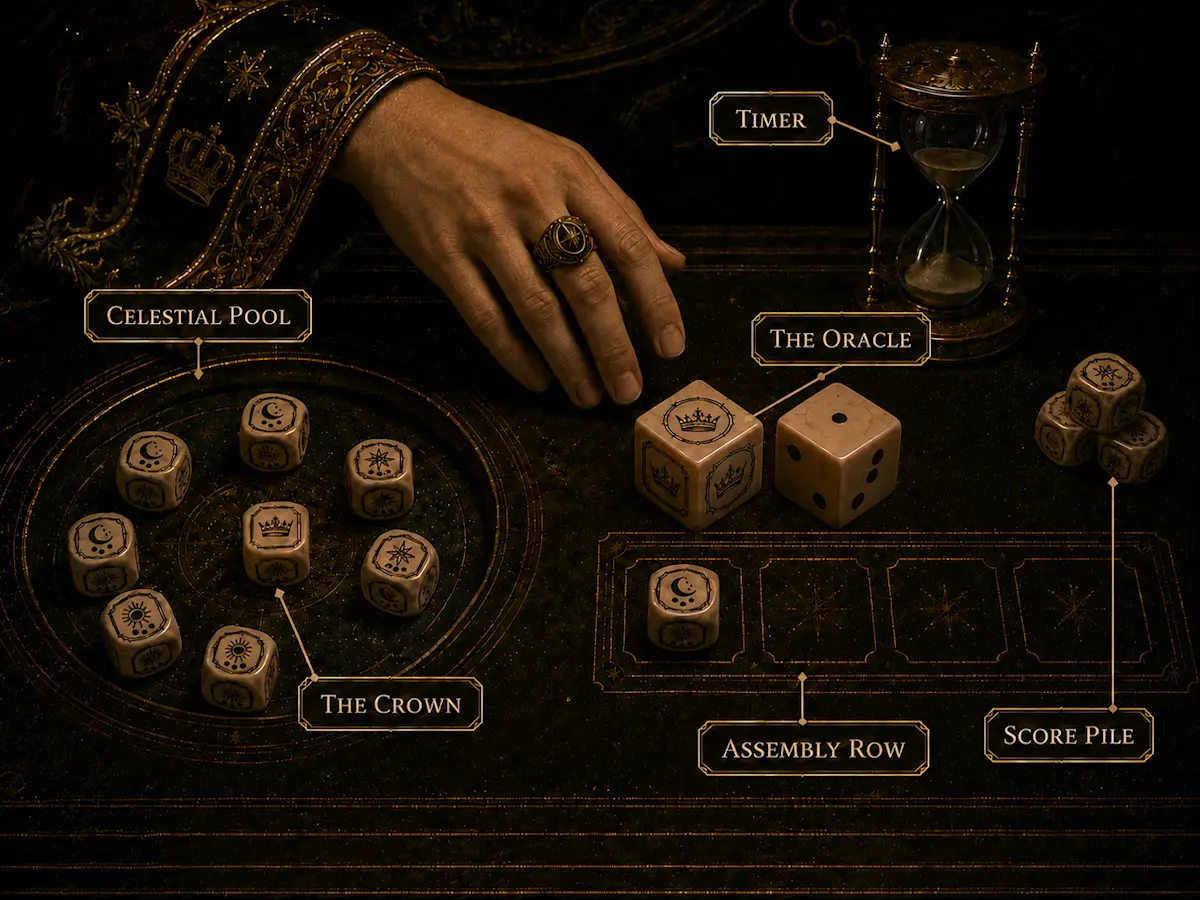





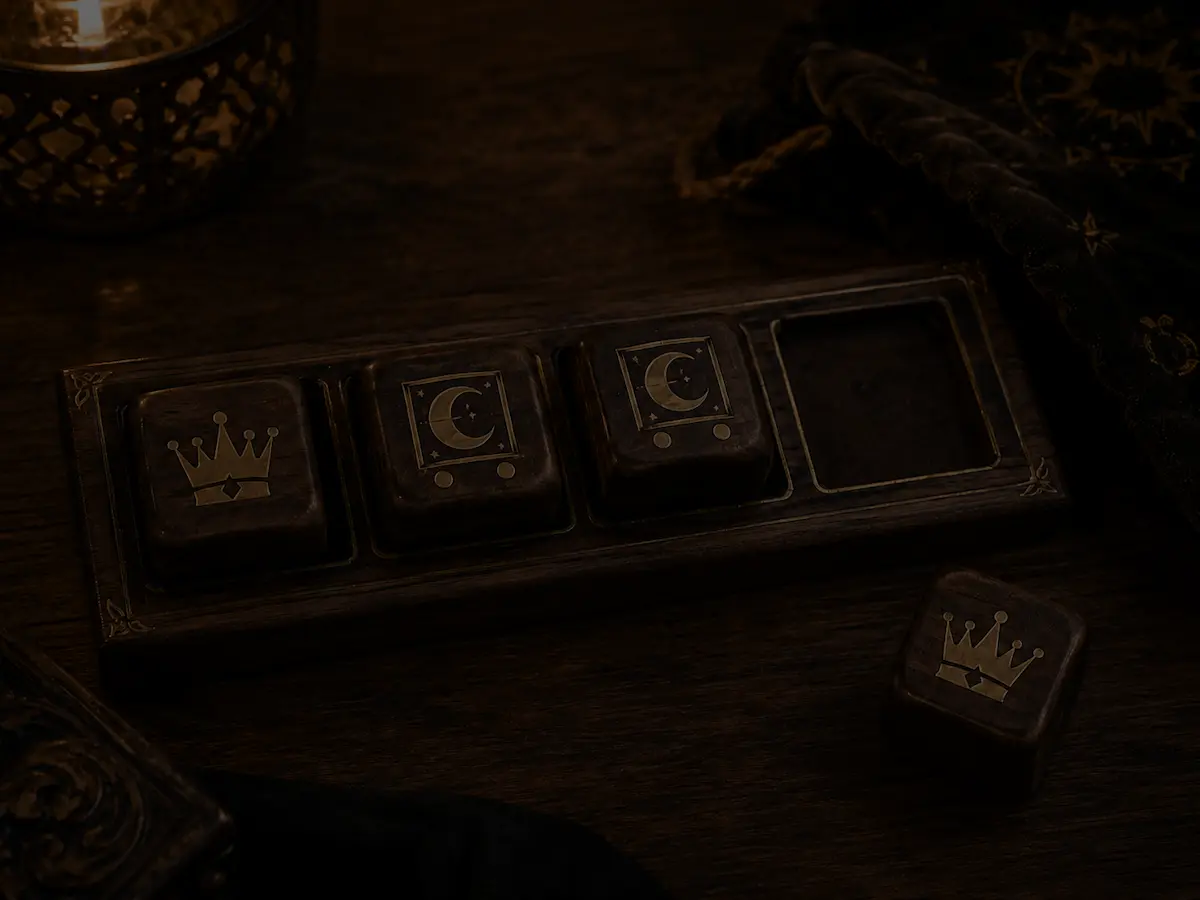

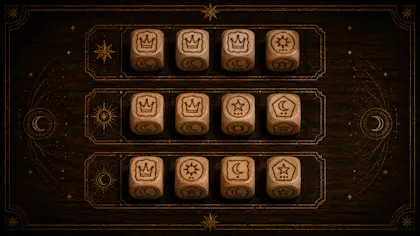

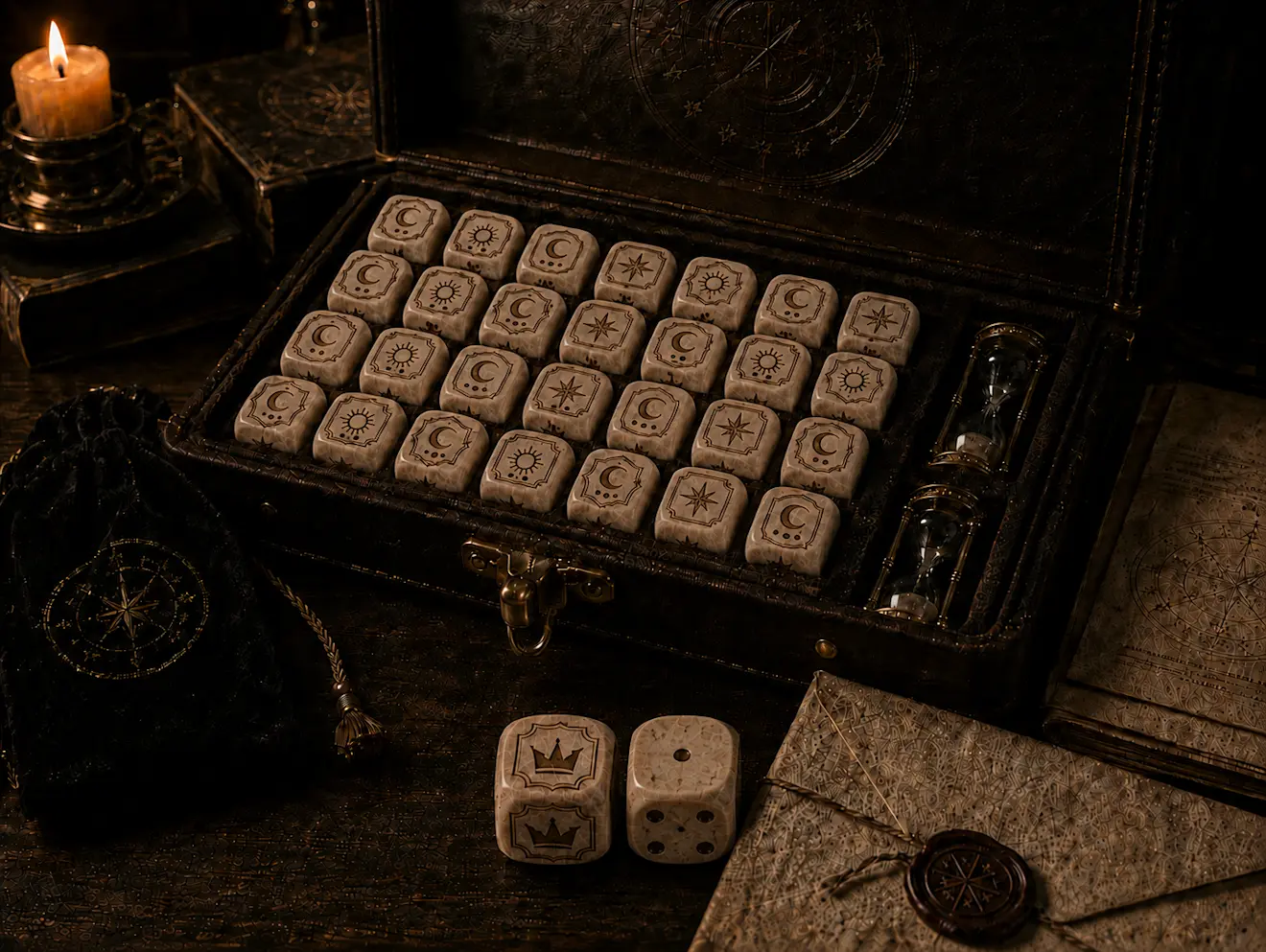




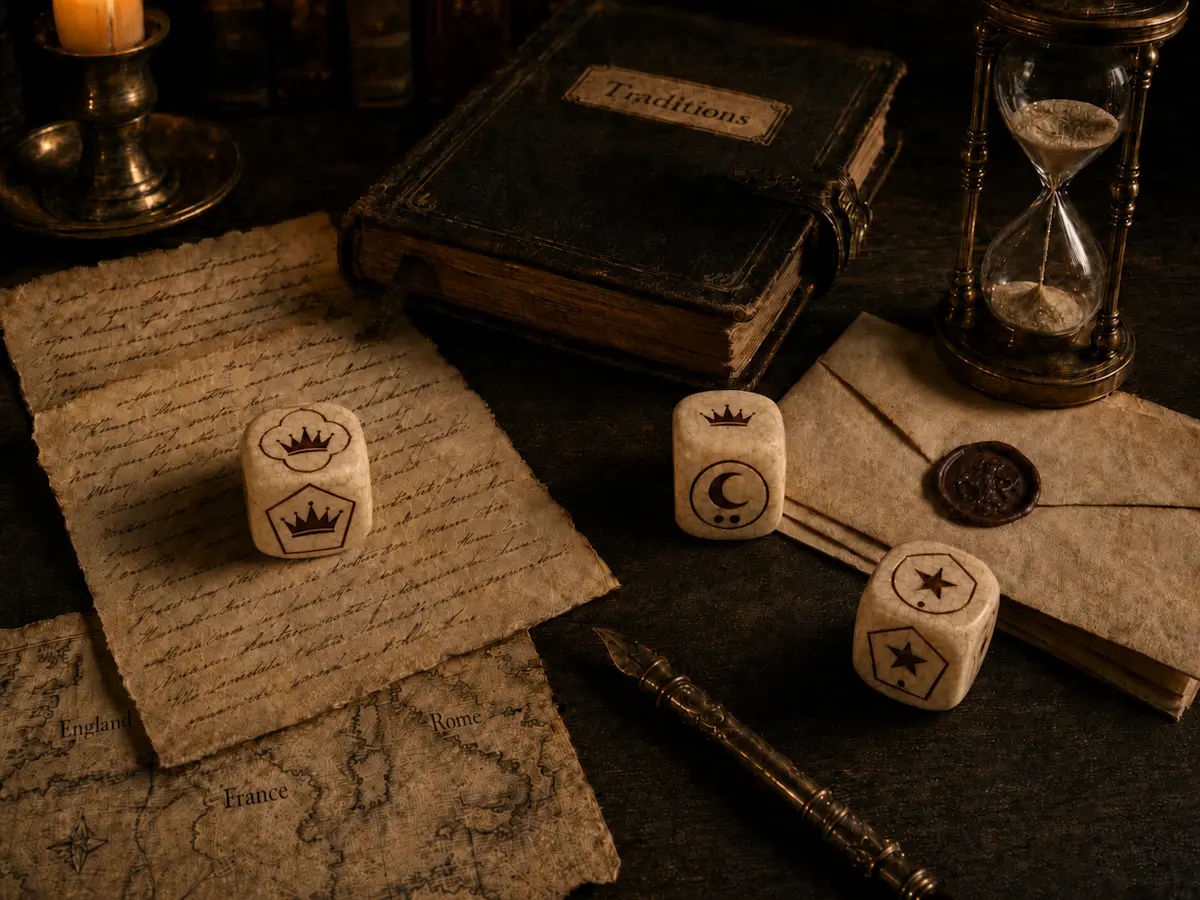










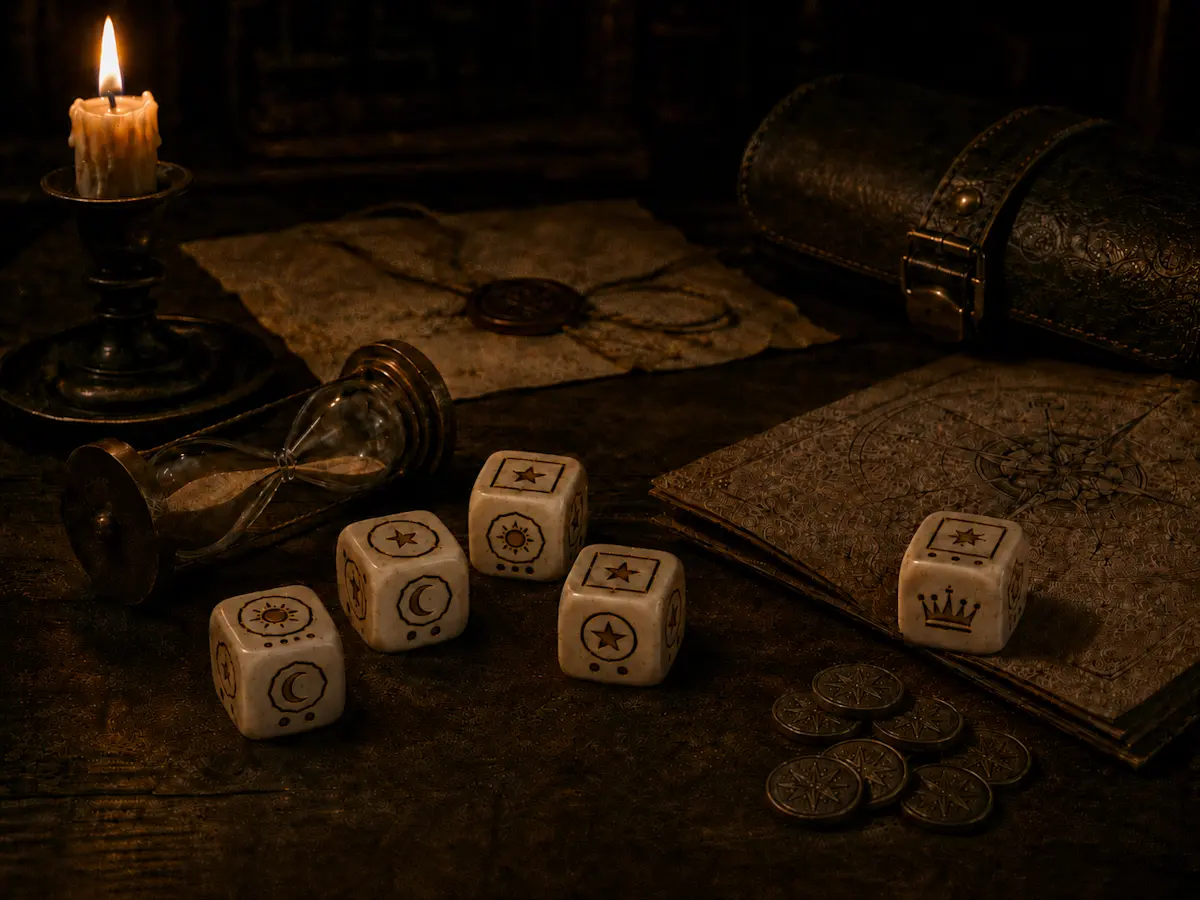
 Basics
 Rules
Rules Table Customs